Rizon Card Review: What 6.7 Out of 10 Actually Means
Rizon is a crypto card that turns your stablecoin balance into an ordinary Visa that pays for coffee, groceries and hotel rooms. The idea is simple and, for the people it was built for, it works: top up with USDC or USDT over a few chains, spend in dollars for nothing, and get 2.5% back. The weak spots are elsewhere — a physical card price the company will not print, a help centre that explains eligibility by passport while the card page explains it by address, and a small pool of user reports about fees charged before verification finished. My score is 6.7 out of 10, and the reason it is not higher is written out in the table below.
If you hold a Latin American or Asian passport, or you live in the United States, Japan, Singapore, the UAE, Brazil or Mexico, this is one of the more interesting cards in the category. If you are Russian-speaking and wondering where you stand: Rizon decides on your citizenship, Russia and Belarus are not on the supported list of 44 nationalities, and no source I found says otherwise. That closes the door regardless of where you live. The same goes for anyone whose passport is not on the list, however long they have lived in a supported country.
The conditions described below are current as of 21 October 2026.
Table of Contents
- What I scored, and why
- Will They Give You the Card
- How to Get It
- Fees and What You Actually Pay
- How to Top Up
- Paying With It Every Day
- What Can Go Wrong
- Why This Card Behaves The Way It Does
- A Note On Regulation, If You Are Cross-Border
- What to Take Instead
- Who I Would Recommend It To
- Frequently asked questions
What I scored, and why
| Criterion | Mark | Why |
|---|---|---|
| Who can get it | 6 / 10 | Availability runs on citizenship, 44 nationalities including the US, Japan, Singapore, UAE, Brazil and Mexico; the card page claims 122+ countries by residence; Russia and Belarus not stated |
| Cost | 6 / 10 | Maintenance and top-up free, spending in USD free, non-USD 1.7% plus $0.1, ATM $1 plus 0.65%; card price reads only “Check app for the price”, Emerald from $5.59 a month |
| Top-up options | 9 / 10 | On-chain deposits free over Arbitrum, Solana, Base, Polygon, Optimism, Avalanche and BSC; USDC and USDT are the unofficial word |
| Reliability and complaints | 5 / 10 | Issued by Signify Holdings and Nimbus LLC (Rain); Trustpilot shows 8 reviews, mostly one-star; unofficial complaints about a fee before KYC and manual checks past 24 hours |
| Everyday use | 9 / 10 | Virtual and physical Visa Platinum, Apple Pay and Google Pay, ATMs up to $250 per withdrawal |
| Total | 6.7 / 10 | Strong on the boring parts of daily spending, soft on transparency and on who exactly gets served |
Read the two nines and the five together. Rizon is genuinely good at the thing most people want: loading stablecoins and spending them without thinking about crypto. It is weak on the things that decide whether a company will still be here in two years and whether you can get your money out of a chatbot when something goes wrong.
Will They Give You the Card
The short answer is: it depends on your passport, not on where you live, and that is the single most important thing on this page.
The card page says the services are “intended for people who live in and are domiciled in” the United States or Latin American countries, may be restricted elsewhere, and simultaneously claims 122+ countries of residence coverage. The help centre says something different and more specific: availability is based on citizenship, evidenced by a passport, not on residence. There are 44 supported nationalities, including Antigua and Barbuda, Argentina, Australia, Bahamas, Barbados, Bangladesh, Belize, Brazil, Cayman Islands, Colombia, Costa Rica, Dominica, Dominican Republic, Ecuador, Egypt, El Salvador, Ghana, Grenada, Guatemala, Guyana, Honduras, Japan, Malaysia, Mexico, Morocco, New Zealand, Pakistan, Panama, Paraguay, Peru, Philippines, Saint Kitts and Nevis, Saint Lucia, Saint Vincent and the Grenadines, Senegal, Singapore, Suriname, Thailand, Turks and Caicos Islands, Uganda, UAE, United States, Uruguay and Zambia.
Russia and Belarus are not on that list. Not stated, absent, and different — I have not found any Rizon page saying a Russian passport works, and the fact the list enumerates 44 countries including small island states makes its silence about Russia and Belarus informative rather than accidental.
That has three practical consequences, and readers ask me about all three.
If you live in Russia, there is no Rizon route I can find. A residence-based reading of the card page would not help, because the help centre’s citizenship test governs, and a Russian passport is not on the list.
If you live in another CIS country, the answer is: check the list for your passport. Kazakhstan, Armenia, Georgia, Kyrgyzstan and Uzbekistan do not appear in those 44. Where your passport is absent, the citizenship test fails.
If you are a Russian citizen living abroad, the citizenship rule is the one that bites. A French or Spanish residence permit does not substitute for a supported passport, because the test the help centre describes is on the passport. A dual citizen holding a supported passport is in a different position from a single-nationality applicant — but I did not find a page that spells out how dual nationality is handled, so treat that as unverified.
There is also a KYC requirement, though the card page itself does not state the requirements. In the app, verification has two possible outcomes: “KYC Declined”, which is final and which Rizon says it cannot override, and “Verification Incomplete”, which usually means a typo, an unclear document photo or a poor selfie and which you can retry. Processing time is not stated on the official pages. Unofficial reporting from spendnode.io in October 2026 describes a passport check with a selfie clearing in two minutes in one test, while other sources report manual review beyond 24 to 48 hours. Both can be true — automated pass for clean documents, human queue for anything the system flags.
The cards themselves: virtual, physical, and metal marked “Coming Soon”, all Visa Platinum. Card currency is not stated; USD and EUR accounts both exist.
How to Get It
The application is a phone app, iOS and Android, linked from the card page. You sign up, upload a passport with a selfie, and wait for one of the two verdicts above. What the app does not show is the processing time, and what the website does not print is the card price.
On delivery, the card page says physical cards are delivered globally with an average of 3 days. The help article is more careful: physical cards are available in 49 countries and territories, including the US, Australia, Japan, Singapore, Brazil, Mexico, South Africa and the UAE, with the US limited to 31 states. Average 3 days globally and 49 countries of real availability are different claims, and the second one is the one I would plan around. Delivery cost is not stated, and replacement cost is not stated — both read “Check app for the price”.
For a virtual card there is nothing to wait for. Unofficial sources say a virtual card is provisioned immediately on approval, which matches how these products normally work.
If your verification comes back “Verification Incomplete”, that is the retryable one. Read it as a photo problem before you read it as a rejection. If it comes back “KYC Declined”, the app’s own wording says the decision is final and Rizon cannot overrule it.
Fees and What You Actually Pay
Here is the honest version: Rizon is free to keep and free to load, free to spend in dollars, and quietly expensive if you spend outside dollars or use an ATM. The card price is the missing number.

| Fee or limit | What Rizon publishes |
|---|---|
| Card issuance (virtual, physical, additional, replacement) | “Check app for the price” |
| Account maintenance | Free |
| Deposit | Free, no limit |
| Spend in USD | Free |
| Spend in a non-USD currency | 1.7% + $0.1 (Emerald listed as 1.02%, page garbled, verify) |
| Trading fee | 1.7% (Emerald 0.85%) |
| ATM withdrawal | $1 plus 0.65% of the amount |
| Emerald subscription | From $5.59 per month |
| Deposit, card spend, sends | “No limit” |
| ATM withdrawals | Up to 3 per 24 hours, max $250 per withdrawal |
Three everyday payments, worked through, so you can see which line hits.
A $30 lunch in Mexico City, paid on the physical card, in pesos. The 1.7% plus $0.10 non-USD fee applies to the conversion. Not fatal, but it means the “free card” framing only holds while you stay in dollars.
A $12 streaming subscription billed in a euro-denominated merchant account. The same 1.7% plus $0.10 applies. Small, and it accumulates quietly across every monthly charge that is not in dollars.
Withdrawals cost $1 plus 0.65% of the amount. And the cap bites: over $250 per withdrawal or more than three in a day, it stops. That is not a budgeting limit, it is a usability limit if you are somewhere cash is normal.
There is a tier above Standard, the Rizon Emerald subscription from $5.59 per month, which cuts FX, trading and transaction fees by 50%. The card page also mentions unnamed “higher tiers” unlocking premium benefits as you spend. Unofficial pricing from spendnode.io in October 2026 gives a Standard virtual card at $10 one-time, Gold and Emerald virtual cards free, physical cards at $49.99 for Standard, $24.99 for Gold and included with Emerald, and plans at Standard free, Gold $3.99 a month, Emerald $6.99 a month with a three-month minimum. Take all of that as unofficial, and note that it contradicts the official Emerald price of $5.59.
Here is the same unofficial pricing laid out, so you can see how the plans stack up. Read it as one source’s October 2026 snapshot, not as a promise, because the official page gives a different Emerald number and no card prices at all.
| Item | Unofficial figure (spendnode.io, October 2026)* |
|---|---|
| Standard virtual card | $10 one-time (unofficial)* |
| Gold virtual card | Free (unofficial)* |
| Emerald virtual card | Free (unofficial)* |
| Physical card, Standard | $49.99 (unofficial)* |
| Physical card, Gold | $24.99 (unofficial)* |
| Physical card, Emerald | Included (unofficial)* |
| Standard plan | Free (unofficial)* |
| Gold plan | $3.99 per month (unofficial)* |
| Emerald plan | $6.99 per month, three-month minimum (unofficial)* |
*Figures marked unofficial per third-party sources. Official Emerald fee is from $5.59 per month.
One structural point the numbers make for you: a paid plan is only worth it if the fee it saves exceeds the fee it charges. On Standard, a $5.59 monthly subscription is justified the moment you spend a few hundred dollars a month outside the dollar at 1.7%, ignoring the trading-fee discount. If you travel rarely and spend in dollars, the free tier is the correct tier, and no upgrade will change that.
That contradiction is not a detail. If you are deciding whether Emerald is worth it, the number you need is the number in your app, on the day you sign up — not a reviewer’s October figure and not a help-centre page that renders as 1.02% with the formatting broken.
How to Top Up
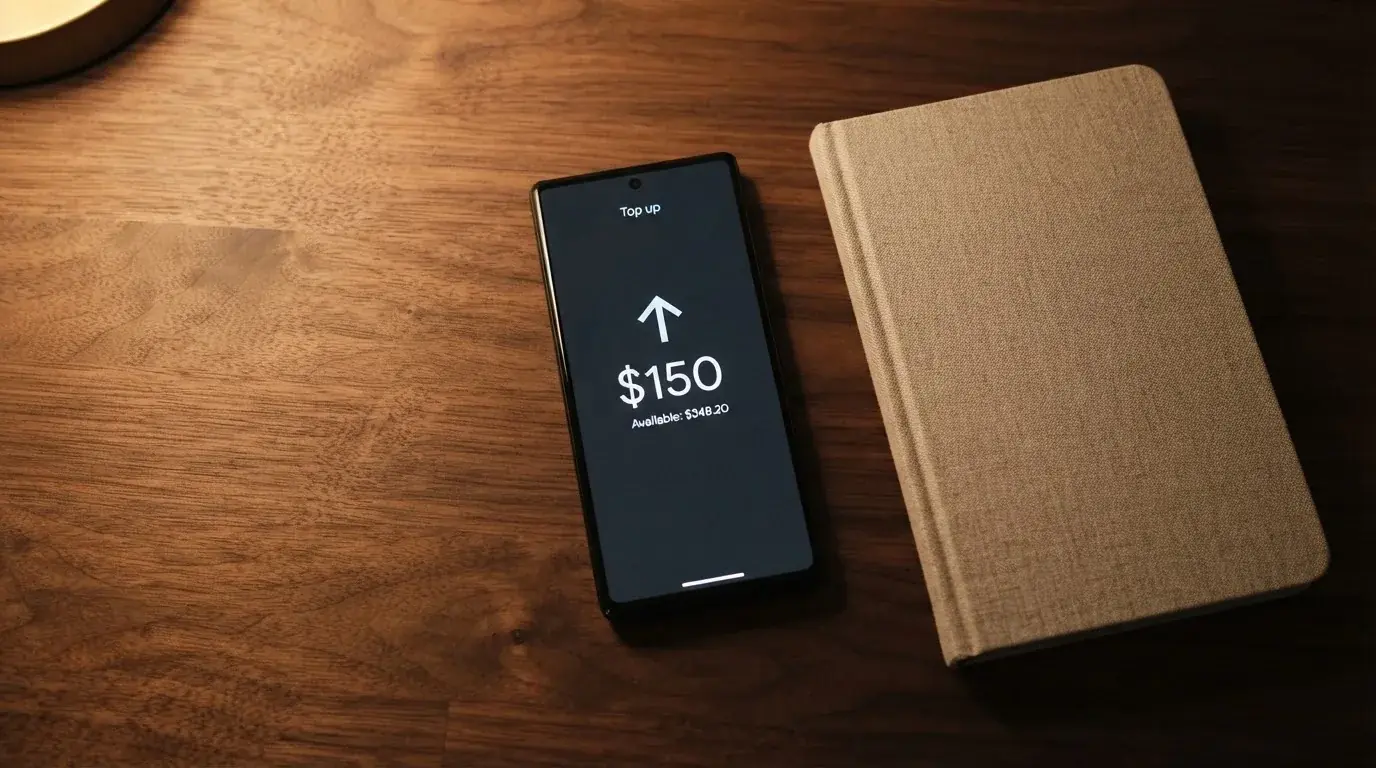
Top-up is the strongest part of the product and the reason it scores 9 out of 10. Deposits are free and carry no limit, and they arrive over seven networks: Arbitrum, Solana, Base, Polygon, Optimism, Avalanche and BSC. Unofficial sources say the coins are USDC and USDT on Polygon, Optimism or Arbitrum, plus US bank transfer and credit card; the official help page lists more chains than that but does not name the coins on the page I read. Accepted coins, minimums and who pays the network fee are not stated.
Getting money off the card is where the asymmetry shows. On-chain withdrawal costs the network fee plus 0.1%. An international send costs the network fee plus 0.1%. A send to another Rizon user is free. What happens to a leftover balance if you close the account is not stated — and that is exactly the question to ask before you close anything.
The chain matters more than it looks. On Ethereum-standard chains a token transfer can need the network’s own currency in the wallet to pay for gas, so a wallet holding USDT and nothing else may be unable to send it. Circle lists USDC as natively supported on 38 networks as of 16 September 2026, including Ethereum, Solana, Base, Polygon PoS, Avalanche, Arbitrum and Stellar, and USDT has been issued on Ethereum, Tron, Solana, Polygon, Avalanche and others — but Circle stopped supporting USDC on Tron in February 2024, so “USDC over TRC20” is not a native option. Tether also states that it disables tokens in wallets on the OFAC sanctions list and has frozen funds tied to illicit activity. Stablecoins are not censorship-proof, and that is a property of the asset, not of the card.
The practical sequence is short: pick a network the card supports, send a small test amount first, wait for it to land, then send the rest. A deposit to the wrong network or an address belonging to a different chain can be lost or need manual recovery with no guarantee, because blockchain transfers are irreversible.
Paying With It Every Day
This is the other 9 out of 10. The virtual card is a Visa Platinum, Apple Pay and Google Pay both work, and unofficial sources confirm the mobile wallets and immediate virtual provisioning. Each payment draws down a balance you already hold rather than extending credit, so the card cannot overdraw.
Rewards are 2.5% back on eligible purchases online, in stores and at ATMs, redeemable from a cashback balance, with RizPoints accruing on spending. The payout currency is not stated. The official card page says 2.5%, but eligible purchases are defined at Rizon’s discretion.
App quality is decent by third-party app-store listings, which are unofficial and undated: Google Play shows “RIZON: Stablecoin Finance” at about 4.3 out of 5 from roughly 3,500 ratings, and the App Store shows 4.0 from 144 ratings. The official site shows no ratings and I did not read the store pages myself, so treat those figures as a rough signal rather than a measurement.
Two things I could not find anywhere, official or otherwise: a list of blocked merchant categories, and a dispute or chargeback article in the help centre. For a prepaid-style card that absence is worth weighing. A merchant category code is the four-digit number that classifies a business by what it sells, and gambling sits under 7995 — a category many issuers block on specific cards by policy rather than by law, with the blocked list differing by issuer. Rizon does not publish its list, so if a card works everywhere else and fails at one category of shop, that is the likely reason and there is no way to check it in advance. If a charge goes wrong, the help centre does not visibly tell you what happens next.
What Can Go Wrong
The category has a bad history, and Rizon sits inside it. Visa terminated its global agreements with FTX on 13 November 2022 and the FTX US debit card was wound down. WaveCrest, a Visa issuer that supplied crypto card brands, was suspended by Visa in Europe in 2018, closing all WaveCrest-issued Visa programmes. Programme shutdowns follow a pattern: a notice period, then loading and spending stop, then users are asked to withdraw what is left.
Rizon’s own structure is worth reading carefully. Rizon Technologies, UAB makes the products available; the card itself is issued by Signify Holdings Inc. and its subsidiary Nimbus LLC (Rain). Some Medium posts and aggregators name Third National as the issuing bank, which I could not verify. Rizon describes the wallet as non-custodial, meaning you keep full control and hold the recovery phrase yourself, with biometric login, “smart fraud protection” and the ability to lock and unlock physical cards in the app. Two-factor authentication and insurance are not mentioned.
Non-custody is a real trade, not a free upgrade. Control means the recovery phrase is yours: anyone who obtains those 12 to 24 words can restore the wallet and spend the funds, transfers are typically irreversible, and a stolen key has no built-in recovery because the network cannot freeze or return funds. Custody has the opposite risk profile — Mt. Gox, Coincheck and Ronin Network are the reference points for what happens when you trust a holder. Neither model is safe by default; they fail differently.
Then there are the specific complaints. The official record of incidents is not stated, so what follows is user-reported and secondhand through an aggregator, with the underlying threads not opened and unverified. The themes: a virtual card issuance fee of roughly $3.50 charged before the eligibility or KYC check finished; manual KYC review running past 24 hours against advertised minutes; slow recovery on a wrong-network deposit; refund requests stuck in chatbot loops. The aggregator says Rizon acknowledged the onboarding flaw and planned to add a country-selection step.
On Trustpilot, the Rizon profile shows about 2.4 out of 5 from 8 reviews, mostly one-star. Eight reviews is a sample too small to conclude anything from, and the profile name collides with an unrelated IRC network, so treat it as noise with a hint of signal. What I would take from it is not “Rizon is bad” but “Rizon is young, and its onboarding is where young products break.”
I also looked for anything official on enforcement. Nothing dated turned up on licences, issuer changes or fines in 2025 or 2026, which is reassuring as far as it goes — but silence is not clearance. What I can say is that Rizon’s own footprint names two regulated relationships, and those are the places to watch: an e-money issuer changing partner, or a network suspending a programme, is the realistic bad day for a card like this. It has happened before, repeatedly, to other brands.
One more angle worth naming: what a dispute would look like if it happened. A chargeback is a refund the issuer orders to settle a disagreement, with reason codes such as fraud, duplicate billing or goods not received, and the rights behind it come from card-network rules and national regulations rather than from the crypto brand. For a prepaid-style card like this, coverage varies and should not be assumed — and since I could not find a dispute or chargeback article in Rizon’s help centre at all, you should treat the practical remedy as unproven until you see it in writing.
I found no dated news on licences, issuer changes or fines in 2025 or 2026. The metal card is still “Coming Soon”. Support is a help centre and a contact email, with no phone or live chat mentioned and no hours stated; the app language can be changed, and whether Russian is among the options is not stated.
Why This Card Behaves The Way It Does
Before the comparison, a short piece of background, because a lot of what looks like a Rizon quirk is actually how every card in this category works. If you already know this, skip it. If you have been declined by a shop for no clear reason, this is the part that explains it.
A card number begins with six or eight digits — the issuer identification number, often called the BIN — that tell the payment network and the merchant which institution issued the card and in which country. The rest identifies your account and ends in a check digit. Merchants can look that prefix up before they approve you. That single lookup is why a card issued in one country can look foreign to a shop in another, and why a prepaid or crypto-linked card sometimes meets extra scrutiny at the till even though nothing is actually wrong with it.
The second thing to understand is the balance. Rizon behaves like a prepaid card, not like a debit card attached to a current account. You convert or top up a balance, and the card spends only that balance, which is why it can never overdraw and why a declined payment just means the balance was short at that moment. A declined authorisation can leave a hold on your funds that lingers for several days, so a refused payment sometimes still shows as money temporarily tied up.
Behind one plastic card sit at least three separate parties: the card network, which routes messages and writes the rules; the issuer, a licensed bank or e-money institution that actually holds the card programme; and the crypto brand, which in Rizon’s case is the programme manager and the face you deal with. That is also why two cards can look identical in the app and behave differently at a shop — the issuer, not the app, decides the risk settings.
There are two more mechanisms that will show up in your statement. Address verification compares the numeric parts of the billing address you type against the issuer’s records; it is mainly a US, Canadian and UK service and is generally unavailable on foreign-issued cards, which is another source of unexplained declines at checkout. And online payments usually pass through a step that adds an identity check — Visa calls its version Visa Secure — which either approves you silently or sends a one-time code or a biometric prompt. When you add the card to Apple Pay or Google Pay, the phone replaces the number with a device-specific token and a fresh one-time code per payment, and the issuer can separately restrict that token to phones only, or block it entirely.
Finally, the rules around the asset itself are stricter than the rules around the card. Tether’s USDT and Circle’s USDC are dollar-pegged and between them hold about 90% of stablecoin market capitalisation, and Circle says USDC is redeemable 1:1 for dollars and fully backed by cash and equivalents with monthly reserve attestations. But stablecoins can and have broken their peg: TerraUSD collapsed in May 2022, and USDC wobbled in March 2023. Tether also states it disables tokens in wallets on the OFAC sanctions list and has frozen funds tied to illicit activity. So “the coin is stable” is a description of a design goal, not a promise.
A Note On Regulation, If You Are Cross-Border
Because the people reading about Rizon often read it from somewhere the card does not serve, this part is less about Rizon than about the rules that decide which cards you can hold at all.
Two regimes do most of the work. In the EU, customer due diligence covers your name, address, date of birth, nationality and identity documents, plus a sanctions check and a politically-exposed-person assessment; if it cannot be completed, the institution must decline the transaction or end the relationship, which is the regulatory reason behind that final “KYC Declined” screen. In the US, the customer identification programme requires name, date of birth, address and an identification number, and electronic checks also validate proof-of-address documents. In both places, nationality is screened separately from residence, because sanctions and issuer policy follow citizenship and country of birth as well as your address.
The EU’s crypto regime, MiCA, took legal effect in June 2023. Its rules for stablecoins and asset-referenced tokens applied from 30 June 2024, and the remaining provisions, including the crypto-asset service provider rules, from 30 December 2024. A detail that catches people out: under MiCA, e-money tokens may be issued only by a credit institution or an electronic money institution. That is why a card often sits on two licences at once — MiCA covering the crypto side, and ordinary e-money and payments law covering the card itself — and why you will see both kinds of entity named when you read a provider’s legal page. The transitional period lets providers already operating under national law continue only until 1 July 2026 or until they are authorised or refused, whichever comes first, and ESMA keeps a public register of authorised providers that you can check.
In the US the framing is different again: FinCEN guidance treats administrators and exchangers of convertible virtual currency as money transmitters, while ordinary people buying goods and services with their own crypto are not money services businesses.
And then there is the reason many readers are looking at foreign cards at all. After Visa and Mastercard suspended operations in Russia in March 2022, cards issued by Russian banks stopped working abroad. That single event is why people who left look for cards issued elsewhere, and it is also why passport-based eligibility lists like Rizon’s have become the thing people check first — including readers who live in Russia, in other CIS countries, or hold Russian citizenship while living elsewhere. In all three cases the citizenship screen is the operative test, and Russia’s absence from it settles the question. None of this is advice on how to get around a rule; it is what the rule says.
What to Take Instead
I want to be fair to the alternatives here, so the table is on the same basis as the Rizon table: score, card, who it is for, and where it hurts.
| Rizon | MetaMask | KAST | Zeal | |
|---|---|---|---|---|
| Score | 6.7 / 10 | 7.1 / 10 | 6.1 / 10 | 6.1 / 10 |
| Card | Visa Platinum, virtual and physical, metal coming soon | Mastercard, virtual instantly, Metal $199/year | Visa Platinum, Visa Infinite metal and gold, other designs, up to 10 cards | Visa, virtual, addable to Apple Pay; physical not stated |
| Eligibility basis | Citizenship, 44 nationalities | Residence, sign-up in 45 listed countries, proof of residency | Residence list shown at KYC, ID nationality also matters | Issuance depends on eligibility and regional availability; live in EU, UK, Brazil, Colombia, Mexico, Japan, Singapore, Philippines, Indonesia, Thailand |
| Card cost | “Check app for the price” | Virtual free, Metal $199/year | Standard 0, Premium $1,000/year, Private $10,000/year | Not stated |
| Non-USD spend | 1.7% + $0.1 | No foreign transaction fee, Mastercard rate | 0.5%–1.75% depending on country and programme | No additional FX fee, Visa wholesale rate |
| Rewards | 2.5% on eligible purchases | 1% virtual, Metal headline 3% capped at first $10,000 | 1.5% / 2% / 3% by tier, capped monthly | Up to 4% cashback in GNO, needs GNO held in the card Safe |
| Weak spot | Unprinted card price, citizenship gate | Fee amount not stated; US and UK sign-ups temporarily closed | Premium and Private cost thousands a year | No published fee schedule |
MetaMask scores highest at 7.1 and is the pick if you want a card that spends straight from your own wallet on Linea, Base, Monad and Solana, with mUSD, wETH, EURe, GBPe, USDC and USDT named as tokens. Two catches: the pages read say only “a minimal fee for each transaction” with the amount behind a link, and US and UK sign-ups were temporarily closed per the FAQ.
KAST at 6.1 is the one with the most generous published fee schedule: stablecoin top-up 0%, USD spend 0%, transaction fee 0%, mobile wallets 0%, non-USD FX 0.5% to 1.75%, declined payments $0.50, under-$25 non-USD transactions $0.10. But the tiers are $0, $1,000 a year and $10,000 a year, billed annually upfront, with a $1 monthly inactivity fee after 12 months. It is also the strictest on eligibility: its own text says that living in a supported country while holding an ID from a restricted region can still make you ineligible, that dual citizens may pass with an ID from a supported country, and that a VPN does not bypass this.
Zeal at 6.1 runs in much of the same geography as KAST and has the cleanest FX statement — no additional FX fee, conversion at the Visa wholesale rate — plus up to 4% cashback in GNO, which you must already hold in the card Safe to qualify. Rates can change. No fee schedule is published and no physical card is mentioned.
Where I would not go: anyone whose only plan is to hold crypto long-term and pay with it occasionally. Rizon’s Emerald at $5.59 a month and KAST’s Premium at $1,000 a year are both ways of paying for access. And anyone hoping a crypto card replaces a normal bank card permanently. It is a spending tool off one balance.
Who I Would Recommend It To
I would recommend Rizon to someone who already holds a supported passport, keeps a stablecoin balance they actually spend, and wants a Visa that works in Apple Pay without a monthly account fee. I would recommend it specifically if you are in Latin America, Southeast Asia, Japan, Singapore, the Gulf or the US and you are tired of conversion mark-ups on a prepaid card.
I would not recommend it to a Russian passport holder anywhere in the world, because the citizenship list excludes it. I would not recommend it to anyone planning a long holding period, because the free tier is a spending tier, not a savings product. And I would not recommend it to someone who needs a published price list, because the price of the physical card is not on the website — you find out in the app, on the day.
The honest summary is that Rizon is a well-built card with a weak paper trail. The mechanics — free loads, free dollar spend, seven chains, two mobile wallets, a non-custodial wallet — are better than most of the category. The disclosures — unprinted card price, a help centre contradicting its own card page on eligibility, a garbled Emerald fee, no dispute policy I could find, an eight-review Trustpilot profile, and a small set of onboarding complaints that the company apparently acknowledged — are thinner than the mechanics deserve. At 6.7 that balance is exactly what I see.
Frequently asked questions
What is the Rizon card?
Rizon is a Visa Platinum card you load with stablecoins and spend like any payment card. It works as a stored balance, not credit: you deposit first, and the card spends only what is there. A virtual card is issued in the app, a physical one on request, and a metal card is coming soon.
Is Rizon a bank?
No, and that shapes your expectations. Rizon is a card programme and a wallet, not a deposit-taking bank, so your balance is not a bank deposit and no deposit guarantee scheme should be assumed to cover it. The card page names Signify Holdings Inc. and its subsidiary Nimbus LLC (Rain) as the issuers.
Who owns Rizon?
Rizon Technologies, UAB is behind the product, but it does not issue the card itself. Issuance sits with Signify Holdings Inc. and its subsidiary Nimbus LLC, operating under the Rain brand, while Visa licenses programmes rather than issuing crypto cards. So Rizon is the front end you deal with; the regulated relationship sits behind it.
Is the Rizon card available in my country?
Availability is decided by citizenship, not residence: the help centre says it is based on your passport, across 44 supported nationalities. The card page separately claims 122+ countries by residence, which contradicts it. Russia and Belarus are not stated and neither is on that nationality list, so treat both as unavailable.
Can I use the Rizon card in other countries?
Spending abroad works, but it is not free. Spending in USD costs nothing; a non-USD transaction costs 1.7% plus $0.10. ATM withdrawals cost $1 plus 0.65%, capped at three per 24 hours and $250 each. Delivery is claimed in 49 countries and territories. Some merchants decline prepaid cards as policy.
How do I get a Rizon card?
You install the app, sign up, and submit a passport with a selfie. The app returns one of two verdicts: KYC Declined, which is final and Rizon cannot override, or Verification Incomplete, usually a poor photo, which can be retried. Unofficial reports say a clean check clears in minutes, others describe review past 24 hours.
Does the Rizon card require KYC?
Yes, verification is required, though the card page does not spell out the requirements. As an electronic money product it falls under customer due diligence covering identity documents, a sanctions check and ongoing monitoring. If it cannot be completed, accounts can be frozen pending documents, which is what that final KYC Declined verdict means.
How do I top up the Rizon card?
Deposits are free, unlimited, and on-chain over Arbitrum, Solana, Base, Polygon, Optimism, Avalanche and BSC. Unofficial sources name USDC and USDT on Polygon, Optimism or Arbitrum, though the official page lists more chains without naming coins. Send a small test first: transfers are irreversible, so a wrong-network deposit can be lost.
How do I withdraw money from Rizon?
On-chain withdrawal costs the network fee plus 0.1%, and an international send costs the network fee plus 0.1%. Sending to another Rizon user is free. To take cash out, withdraw to a wallet you control, then move it to a bank. If you close the account, ask in writing what happens to the remaining balance.
Is the Rizon card safe and worth it?
Worth it depends where you spend. In dollars it is free to hold, free to load and free to spend, with 2.5% back on eligible purchases. Outside dollars you pay 1.7% plus $0.10, and ATMs cost $1 plus 0.65%. On safety, the wallet is non-custodial, so you hold the recovery phrase yourself.
Written by the editors at Crypto Card Rating.