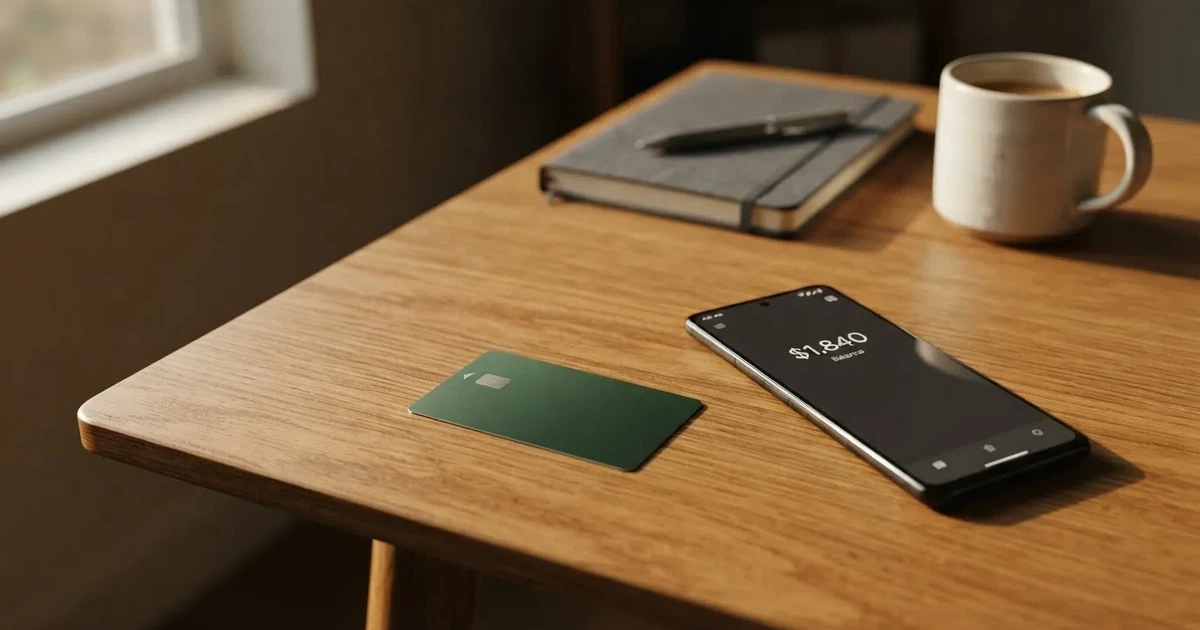
Phantom Cash Card Review: A Virtual Card Spending a Stablecoin Balance, for US Residents Only
Phantom Cash is a virtual Visa debit card that spends the balance of a Cash account inside the Phantom wallet app. It is not a physical card, it is not a bank account, and it is not open outside the United States. My overall mark for it is 5.3 out of 10, which sits in the middle: nothing here is scandalous, but nothing here is especially generous either. The card works as described, the fees may well be thin, and the people it fits are a narrow group — US residents who already hold dollar stablecoins and already use Phantom.
If you are reading this from outside the US, stop here and save yourself the trouble: this card is not for you, and no step in the application changes that. If you are in the US and looking for a card that turns crypto into ordinary spending without cash withdrawals, read on — the details below will tell you whether it fits.
The conditions described here are current as of 21 October 2026.
Verdict: 5.3 out of 10, and a narrow fit
Let me give you the number first, because you should know where you stand before you read the fine print. Phantom Cash scores 5.3 out of 10 in my assessment. It gets its marks in the places you would expect from a crypto card that nobody has written a bad review about, and loses them in the places that actually decide whether a card is useful.
Who it suits: US residents, excluding New York, who already keep dollar stablecoins in Phantom, who are comfortable with a virtual card that lives in Apple Wallet or Google Wallet rather than in a physical wallet, and who want to spend a stablecoin balance directly rather than juggling a bank account and an exchange.
Who it does not suit: anyone outside the US, anyone who needs a physical card, anyone who needs to withdraw cash from an ATM, anyone who wants published fee numbers before signing up, and anyone whose main draw would be cashback or rewards — there is no card cashback stated anywhere in the public material.
| Criterion | Mark | Why |
|---|---|---|
| Who can get it | 4 / 10 | US only, excluding New York, based on residence |
| Cost | 7 / 10 | Fees officially not disclosed; unofficial listings say issuance, replacement and inactivity are free, top-ups are free, and an international transaction costs 1% + $0.30 |
| Top-up options | 4 / 10 | The card spends the CASH balance; Cash is funded by Apple Pay, Google Pay, a debit card or a bank, and withdrawals go to a bank or a Solana wallet. Direct crypto top-up is not named |
| Reliability and complaints | 6 / 10 | Issuer Lead Bank, programme manager Bridge Ventures LLC, payments through Stripe; the virtual card is being replaced during an issuer change with no dates given; no complaints found |
| Everyday use | 5 / 10 | Virtual Visa plus Apple Wallet and Google Wallet only; unofficial listings say there are no ATMs |
| Total | 5.3 / 10 | A working card for a narrow group, with more unknowns than a careful buyer would like |
The line that decides the total is the third one. A card that only spends whatever sits in a Cash account, and whose top-up routes are Apple Pay, Google Pay, a debit card or a bank transfer, is not really a crypto card in the sense most people mean it. It is a prepaid card whose balance happens to be denominated in a stablecoin. That is a fine product, but it is not the product someone shopping for “spend my Bitcoin” is looking for — and Phantom’s own pages do not claim direct crypto funding of the card balance, so you should not assume it either.
Will they give you the card?
They will give it to United States residents, and to nobody else. New York is excluded. That is the whole eligibility rule as the card’s public pages describe it: US only, excluding New York, decided by residence. Russia and Belarus are not mentioned at all — but since the rule is the United States, “not mentioned” and “not available” come to the same result.
One clarification that matters, because people conflate the two constantly: this is a residence rule, not a citizenship rule. A Russian citizen living in Texas can qualify on residence. A US citizen living in Warsaw cannot, no matter how many passports they hold. The card’s pages also record that KYC is not required for Phantom or Phantom Cash in general; identity verification is required specifically for bank transfers, direct deposit and the debit card. Levels, processing times and rejection reasons are not stated.
How to get it
The application path is short, and short is not the same as thorough. Four steps: fund your Cash balance, complete identity verification, receive the virtual card, add it to Apple Wallet or Google Wallet.
A few specifics you will want. Identity verification is done through Link and is required for the virtual card. The marketing page says verification is handled by Stripe in connection with bank transfers, direct deposit and debit card use. Applicants must be 18 or over. Whether you need proof of address is not stated — and that is a real gap if you have moved recently or your address does not match your documents, because an institution that does not describe its address requirements usually has them.
What you get is a virtual prepaid Visa debit card that works wherever Visa is accepted. No physical card is offered — no delivery time, because there is nothing to deliver. The card’s currency is USD, which is implied rather than stated: the balance is the CASH stablecoin, and the accounting pages describe no other denomination.
| Step | What you do | What to expect |
|---|---|---|
| 1 | Fund the Cash balance | Apple Pay, Google Pay, a debit card or a bank account, depending on region |
| 2 | Verify your identity | Through Link; Stripe handles verification for bank transfers, direct deposit and the debit card; 18+ |
| 3 | Receive the virtual card | Virtual only; no physical card is offered |
| 4 | Add to a wallet | Apple Wallet or Google Wallet, then pay by phone |
Two honest warnings before you start. First, there is no tier structure here — a single card and a single Cash account, with no tiers mentioned anywhere in the public material, so nobody is going to call and offer you a better version. Second, Phantom’s own help centre is currently telling users that their virtual card is being replaced as Phantom moves to a new card issuer, and that the replacement has to be added to Apple Wallet or Google Wallet again. No dates are given for that change. If you were to sign up today and find your card behaving oddly next month, that notice is the first thing to read.
Fees: what a payment really costs
Here is the uncomfortable part. Phantom’s pages say “Fees may apply” and refer you to the Cardholder Agreement. They do not publish amounts. The Cash marketing page says fees are not stated and describes stablecoin trades as fee-free. So the official position is: we will not tell you.

What you can find is third-party data, and I am labelling it as unofficial because the card itself has not confirmed it. Unofficial card-detail listings, last verified September 2026 but partly carried forward from an older dataset, report no card issuance fee, no replacement fee, no inactivity fee, free cash loads, and free purchases in the US. The same listings report a foreign-exchange fee of 1% + $0.30 per international transaction. Treat these as a good-faith estimate of the price, not as a promise by the issuer.
| Fee or limit | Value | Source and status |
|---|---|---|
| Card issuance | No fee reported | Unofficial listing, Sep 2026; official pages say “fees may apply” without amounts |
| Replacement card | No fee reported | Unofficial listing, Sep 2026 |
| Inactivity fee | No fee reported | Unofficial listing, Sep 2026 |
| Cash loads | Free | Unofficial listing, Sep 2026 |
| US purchases | Free | Unofficial listing, Sep 2026 |
| International transaction | 1% + $0.30 | Unofficial listing, Sep 2026; not confirmed by the card |
| ATM withdrawal | Not available; ATM fee not disclosed | Unofficial listing, Sep 2026; official pages do not state ATM terms |
| Stablecoin trades | Described as fee-free | Phantom Cash marketing page |
| Daily spending limit | $2,000 by default, up to $5,000 on request | Unofficial listing, Sep 2026 |
| Monthly limit | Not disclosed | Neither official nor unofficial pages state it |
| Tiers | None; a single card and Cash account | Phantom Cash marketing page |
Now the part you actually came for: three ordinary payments, and which of these lines touches each one.
A $30 grocery shop in Texas. Under the unofficial figures, US purchases are free and this costs you $30. But this is where the daily limit matters — $2,000 a day by default, so $30 is nowhere near it. Watch one thing instead: if you pay by phone through Apple Wallet, some merchants apply a small authorisation hold, and a declined authorisation can leave a hold on your balance for several days.
A dinner in an international location. This is an international transaction, so the unofficial 1% + $0.30 fee applies, plus whatever the merchant’s own currency handling does. This fee is charged on top of whatever spread sits in the conversion. If you are in the US most of the time, international fees are not something you will see on your statements.
Ordinary daily spending like fuel is free under the unofficial figures, and well under the $2,000 daily cap. The real constraint is not fees but the prepaid model: the card spends the Cash balance and cannot overdraw, so a large bill fails if the balance is not there. There is no credit line, no float, no grace period.
What I cannot tell you, because the card does not say: what a declined transaction costs, whether there is a fee for adding to Apple or Google Pay, and what the monthly ceiling is. If the Cardholder Agreement lists them, that document — not this page — is the binding answer.
Top up: how money gets into the card
The card spends the Cash account balance, and CASH is a stablecoin. That is the single most important sentence in this section, because everything else follows from it: this is a prepaid balance, not a bank balance.
Cash is funded by Apple Pay, Google Pay, a debit card or a bank account, depending on your region. Fees and minimums for those routes are not stated. Withdrawals go to a bank account (US) or to a Solana wallet. Fees and timing for withdrawals are not stated on the pages I read, and neither is what happens to a balance when you close the account — so if you plan to leave, ask support before you leave, not after.
| Top-up route | What it is | What is not stated |
|---|---|---|
| Apple Pay | Funds the Cash balance in supported regions | Fees, minimums |
| Google Pay | Funds the Cash balance in supported regions | Fees, minimums |
| Debit card | Funds the Cash balance in supported regions | Fees, minimums |
| Bank account | Funds the Cash balance; verification required | Fees, timing, US-only or wider |
| Direct stablecoin transfer to the card balance | Not named in the public material | — |
| Withdraw to a bank account (US) | Possible | Fees, timing, closure behaviour |
| Withdraw to a Solana wallet | Possible | Fees, timing |
Notice the fourth row. A lot of people arrive at crypto cards expecting to send USDC on a network and start spending. Phantom Cash’s public pages do not describe that route for the card balance; they describe stablecoin trades as fee-free, which is about trading inside the wallet, not about loading the card. If you arrived with a stack of stablecoins on another chain and a plan to spend it directly, this is where you should be disappointed, and better to know now than at checkout.
Paying with it every day
Everyday use is where this card is thinnest, and my 5 out of 10 for that criterion is mostly about format rather than quality. You get a virtual Visa that you add to Apple Wallet or Google Wallet, and that is the whole list of formats. There is no physical card, so no handing over plastic at a restaurant, no card for a petrol pump that has no contactless reader, and no fallback when your phone dies. Restricted merchant categories are not stated either, which means you cannot know in advance whether a given purchase will be declined on policy.
Some things that do work in your favour:
- Apple Wallet and Google Wallet both supported, with the tokenised number handled by the phone’s secure hardware rather than by Apple or Google servers.
- Visa acceptance is broad, so wherever a contactless or online Visa payment is taken, the card should work.
- Spending limits are adjustable — unofficial figures put the daily cap at $2,000 by default, raisable to $5,000 on request.
- Stripe handles card disputes for debit card transactions. The process and time frames are not stated.
- Holding CASH is described as earning passive income without lockups, but no rate is given and there is no card cashback stated at all.
That last pair of facts is the honest summary of the rewards story: no cashback, and an unquantified yield on the underlying token. If cashback is the reason you were shopping, stop reading and look at the alternatives below, because every one of them publishes a number.
Two practical warnings. A virtual card means a phone failure is a payment failure — have a backup method for the days your phone is dead or your wallet is locked. And a declined authorisation can leave a hold on your balance for days, which is a common and underappreciated way that a prepaid card leaves you short of money you have already spent.
There is one more everyday-use feature worth understanding rather than fearing. When you add the card to Apple Wallet, the phone does not store your card number: it replaces it with a device-specific number held in the phone’s secure hardware, and each payment carries a one-time security code. That is genuinely safer than a magnetic stripe, because a copied device token is much less useful to a thief than a copied number. The issuer can still restrict a tokenised number — for example block it on phone-only or website-only use — so a tokenised card is not an unlimited-use card. Neither Apple nor Google holds your number in the ordinary sense, but the practical consequence for you is the same: the card stops working if the phone stops working.
One more thing people ask about is online payments. Online card payments often run through a step called 3-D Secure, where the issuer assesses the risk and either approves silently or challenges you with a one-time code or a biometric check. Visa’s version of it is called Visa Secure. You should expect an occasional extra prompt at checkout, and you should expect the possibility that a fraudulent online payment can end up being held against you rather than the merchant, depending on how the challenge was handled. This is one of the areas where knowing the card’s dispute process matters more than usual, and Phantom says Stripe handles disputes without publishing the process or the time frames.
What can go wrong
Four things stand out, in descending order of how much they should worry you.
The issuer change. Phantom’s help centre carries a notice saying your virtual Phantom debit card is being replaced as Phantom moves to a new card issuer, and users should add the replacement to Apple Wallet or Google Wallet. No dates are published. The current arrangement — Lead Bank as issuer, Bridge Ventures LLC as programme manager, Stripe processing transactions and disputes — is what is being changed. Programmes get moved between issuers; that is normal in this industry. It is also the single most reliable way for a card to stop working on a Tuesday without warning. Expect to re-add the card to your wallet at some point.
The unknown fees. Official pages say fees may apply and publish no amounts. Third-party data suggests the fees are low. If you are comfortable with that arrangement, fine. If you are not, the answer is not to guess: read the Cardholder Agreement before you load money.
The structure, not the reputation. Phantom says it is not a bank. Lead Bank issues the card under a Visa licence, Bridge Ventures LLC manages the programme, Stripe processes payments. Phantom also says it does not store KYC information, because verification is handled by Stripe, and that the balance is secured on-chain as CASH. That is a reasonable arrangement, and it is not the same as deposit insurance. Whether a card freeze, two-factor authentication and any insurance are provided is not stated.
The absence of complaints. I searched for complaints and found no Trustpilot or Reddit complaints specific to Phantom Cash. Take that with two grains of salt. Absence of complaints often reflects a small user base rather than a flawless record, and this industry has a documented history of programmes closing: Visa terminated its global agreements with FTX on 13 November 2022, WaveCrest’s European Visa programmes were suspended in 2018, and closures typically mean loading stops, then spending stops, then you are asked to withdraw what is left. That is a sector risk, not a Phantom risk, but you hold the exposure. Support is a Help Center with a “Start a chat” option; languages and hours are not stated.
What about chargebacks and your rights when something goes wrong? A chargeback is a refund ordered by the card issuer to settle a dispute, with reason codes such as fraud, duplicate billing, or goods not received. In the US, debit card reversal rights come from Regulation E, and prepaid-card coverage varies and should not be assumed to match. Phantom says Stripe handles disputes for debit card transactions, but publishes neither the process nor the time frames — so if a purchase goes wrong, you are relying on a document you have not read, handled by a company that is itself mid-switch. That is not an accusation; it is just the amount of certainty you actually have.
Then there is the wider pattern to keep in view, because it is what the industry does rather than what any one company does. Visa and Mastercard do not issue crypto cards to consumers themselves; they license issuers, and they can suspend a programme. Visa said it had terminated its global agreements with FTX in November 2022, and the FTX US debit card was wound down by its issuer. WaveCrest, a Visa issuer that supplied several crypto card brands, was suspended by Visa in Europe in 2018 and all its Visa programmes closed. Neither event says anything about Phantom specifically. Both say that the issuer relationship is the fragile part of any crypto card, and that a card existing today is not a promise about next year.
| Risk | What is actually known | What is not known |
|---|---|---|
| Issuer change | Official notice: virtual card being replaced; add the replacement to Apple/Google Wallet; no dates | When it happens, whether the balance is affected |
| Fees | “Fees may apply” officially; unofficial listings show most items free | The amounts in the Cardholder Agreement, declined-payment fees |
| Custody | Balance secured on-chain as CASH; Phantom does not store KYC data; verification via Stripe | Card freeze, two-factor authentication, any insurance |
| Disputes | Stripe handles disputes for debit card transactions | Process, time frames, prepaid-card reversal rights |
| Complaints | No Trustpilot or Reddit complaints specific to Phantom Cash found | Whether that reflects quality or a small user base |
| Support | Help Center with a “Start a chat” option | Languages, hours, response times |
What to take instead
If Phantom Cash is not your card, the alternatives below are the ones I looked at. Two of them score higher; one scores the same. All three are virtual-first too, and none of them is available everywhere — but their country rules and their fee schedules are published, which is itself a reason to prefer them.
| Card | Score | Who can get it | Card and cost | Notable strengths |
|---|---|---|---|---|
| Phantom Cash | 5.3 / 10 | US only, excluding New York, by residence | Virtual Visa; fees not disclosed officially | No cashback needed, low unofficial fees |
| MetaMask | 7.1 / 10 | Sign-ups open in 45 listed countries and territories, others on a waitlist; proof of residency required; US and UK sign-ups temporarily closed | Mastercard; Virtual free, Metal $199/year | Spends directly from a connected wallet; 1% cashback on Virtual, up to 3% on Metal |
| KAST | 6.1 / 10 | Residence-based list shown at KYC; citizenship and ID also matter, with restricted-region IDs possibly ineligible; Russia and Belarus not mentioned | Visa; Standard $0/year, Premium $1,000/year, Private $10,000/year; virtual and physical | Published fees: stablecoin top-up 0%, USD spend 0%, non-USD FX 0.5%–1.75%; up to 10 cards |
| Zeal | 6.1 / 10 | Programme live in EU, UK, Brazil, Colombia, Mexico, Japan, Singapore, Philippines, Indonesia, Thailand; spend in 150+ countries | Visa; no fee schedule published on the app site or App Store | No additional FX fee, Visa wholesale rate; up to 4% cashback in GNO |
MetaMask is the stronger card on the evidence: a higher score, a published cashback rate, and spending straight from a connected wallet across Linea, Base, Monad and Solana with mUSD, wETH, EURe, GBPe, USDC and USDT named. Two cautions. Its fee is described as a “minimal fee for each transaction” with the amount not published on the pages I read. And its geography is a patchwork — 45 listed countries with a waitlist elsewhere, and US and UK sign-ups temporarily closed, which is worth checking on the day you apply rather than trusting an old blog post.
KAST is the clearest on money. Its fee table is the only one in this comparison where you can read the FX rate before you sign up, and its membership tiers are priced so that the free Standard tier is genuinely usable: cashback of 1.5% on the first $2,000 a month for Standard, 2% on the first $10,000 for Premium, 3% on the first $40,000 for Private. But the membership structure is expensive at the top, and its terms say the currently acceptable tokens are USDT and USDC while its card page also names PYUSD and RLUSD — a conflict you would want resolved before you transfer anything.
Zeal is the simplest of the three and the least documented: no fee schedule is published on the app site or the App Store at all. Its attraction is that it charges no additional FX fee and converts at the Visa wholesale rate, plus cashback of up to 4% paid in GNO, which you must hold in the card Safe to qualify and which can change. If transparent costs are what you care about, Zeal is not the card for you either.
Who I would recommend it to
I would recommend Phantom Cash to a specific person: someone in the US, outside New York, who already keeps dollar stablecoins in Phantom, who is happy paying by phone and has never missed a card in a shop, who is content with a single prepaid balance rather than a bank account, and who can live without a published fee table. To that person it is a tidy, low-cost way to spend a stablecoin balance, and there is nothing wrong with it.
I would not recommend it if any of these apply to you:
- You live outside the US. There is no version of this that works from another country.
- You need cash from an ATM. Unofficial listings say there is no ATM withdrawal at all.
- You want cashback. None is stated, and the alternatives pay a published percentage.
- You want to load the card straight from crypto you hold elsewhere. That route is not described in the public material.
- You need to know every fee before you commit. Phantom does not publish amounts.
- You are uneasy about a card that is mid-issuer-change with no dates announced.
Two further points that are not about this card at all, and that I would rather say plainly than leave out. If your money is on a stablecoin, remember that stablecoins are not guaranteed stable: one collapsed outright in May 2022 and another briefly lost its peg in March 2023. And if you are in the US, the IRS treats digital assets as property, so spending from a crypto-funded balance can be a taxable disposal measured at the value on the date of each payment. I am not qualified to advise you on that and this is not tax advice — but you should budget for it rather than discover it. On the regulatory side, ESMA maintains an interim public register of authorised crypto-asset service providers, which is the first place to check any provider’s standing, and a card often depends on two separate licences: one covering the crypto side and one covering the payment service.
Frequently asked questions
What is the Phantom Cash card?
Phantom Cash is a virtual Visa debit card that spends the balance of a Cash account inside the Phantom wallet app, where that balance is held as the CASH stablecoin. It is prepaid, so it draws on a stored balance rather than a linked bank account. There is no physical card. Phantom says it is a platform provider and not a bank; Lead Bank issues the card under a Visa licence.
Who can actually get a Phantom Cash card?
United States residents only, excluding the state of New York, and the test is residence rather than citizenship. Phantom states that KYC is not required for Phantom or Phantom Cash in general, but identity verification through Link is required for the virtual card and for bank transfers, direct deposit and debit card use. Applicants must be 18 or older. Levels, timings and rejection reasons are not published.
Is Phantom Cash a bank, and who is behind it?
No — Phantom says so itself. The card is issued by Lead Bank under a Visa licence, Bridge Ventures LLC is the programme manager, and Stripe processes transactions and handles disputes. Phantom holds the platform role. Phantom also says it does not store KYC information, since verification runs through Stripe, and that the balance is secured on-chain as CASH. None of that is the same as deposit insurance.
How much does a Phantom Cash card cost?
The official pages say only that “Fees may apply” and refer to the Cardholder Agreement, without publishing amounts. Unofficial third-party listings from September 2026 report no issuance, replacement or inactivity fee, free cash loads, and free US purchases, with a foreign-exchange fee of 1% + $0.30 per international transaction. Unofficial daily spending limits are $2,000 by default and up to $5,000 on request; the monthly limit is not disclosed.
Can I top up Phantom Cash with crypto?
The public material does not describe that. The card spends the Cash account balance, and Cash is funded by Apple Pay, Google Pay, a debit card or a bank account depending on region, with fees and minimums not stated. Withdrawals can go to a bank account in the US or to a Solana wallet. Stablecoin trades inside Phantom are described as fee-free, but that is not the same as loading the card directly with crypto.
Does Phantom Cash work outside the US?
You can use the card where Visa is accepted, and the card can be added to Apple Wallet and Google Wallet, so spending abroad is possible. But you must live in the US, outside New York, to hold it in the first place. Note that international transactions carry an unofficial 1% + $0.30 fee, and merchants may treat a virtual prepaid card cautiously.
Is it safe, and what about the card replacement notice?
The card’s security features are not described in detail — card freeze, two-factor authentication and any insurance are not stated. What is stated is that the balance is secured on-chain, that Phantom does not keep KYC data, and that identity verification runs through Stripe. The help centre does carry an official notice that the virtual card is being replaced as Phantom moves to a new issuer, with no dates given, and users must add the replacement to their wallet again.
What are the alternatives to Phantom Cash?
MetaMask scores 7.1 out of 10, supports sign-ups in 45 listed countries, issues a Mastercard, and pays 1% cashback on the free Virtual tier. KAST and Zeal each score 6.1. KAST publishes a full fee table and offers physical and virtual Visa cards with membership from free to $10,000 a year. Zeal charges no additional FX fee and offers up to 4% cashback in GNO, but publishes no fee schedule at all.
Does Phantom Cash pay cashback or rewards?
No card cashback is stated anywhere in the public material. What Phantom does describe is that holding CASH earns passive income without lockups, but it gives no rate for it, and that is a return on the token rather than a reward for spending with the card. If a percentage back is what you are after, MetaMask and KAST both publish figures, and Zeal publishes a headline rate.
Can I withdraw cash from a Phantom Cash ATM?
Probably not at all. Unofficial card listings from September 2026 state that ATM withdrawals are not available and that no ATM fee is disclosed, and Phantom’s own pages do not state ATM terms at all. Plan instead to spend the balance at shops, online or through Apple Pay and Google Pay, and to withdraw funds to a bank account or a Solana wallet if you need the crypto or the dollars off the card.
Prepared by the Crypto Card Rating editorial staff.