
RedotPay Card Review: An Honest Look Before You Fund It
The RedotPay card is a crypto-linked payment card: you load it from your own crypto, it holds a fiat balance, and you spend that balance like an ordinary Visa card in shops, online and at ATMs. On paper it is one of the more capable cards in this category — a virtual or physical card, Apple Pay and Google Pay, usable worldwide, with a plain 1% conversion fee and no monthly charge. So why does it only score a middling mark overall? Because the single biggest risk with this kind of card is not the fee table; it is whether your account survives its own compliance checks. RedotPay’s own help pages admit freezes tied to KYC and source-of-funds reviews, and users report them too. If your money comes from a normal salary and a normal bank account, this is probably a fine everyday card. If your money comes from P2P trades, mixers, or a chain of transfers that is hard to explain on paper, read the risk section before you deposit a dollar.

The conditions described on this page are current as of 21 October 2026 (verified against official RedotPay help centre articles).
Table of Contents
- Verdict: who this card is really for
- Will they give you the card: the country and citizenship rules
- How to get it: signup, verification and delivery
- What it really costs: Fees and limits
- How to Top up: networks, minimums and the fee that bites
- Paying with it every day: wallets, rewards and the app
- What can go wrong: freezes, the unnamed issuer and unbacked promises
- What to take instead
- Who I would recommend it to
- Frequently asked questions
Verdict: who this card is really for
My overall mark for RedotPay is 6.9 out of 10. That is not a bad score; it is the honest sum of a card that does its job unusually well day to day and has a service layer that some users find frustrating. It earns 9/10 for everyday use and 8/10 for both eligibility breadth and top-up flexibility, and it loses most of its ground in reliability, where it manages only 4/10. The card mechanics are excellent; the trust layer is the wobly part.
Who is it for? It suits crypto holders outside the restricted-country lists who want either a virtual card for online spending or a plastic card they can tap, swipe and use at ATMs, and who can show a clean, explainable source of funds. It does not suit you if you are a resident of one of the restricted places, if you need a card that never freezes, or if you are looking for a bank deposit guarantee — this is not a bank account. It also does not suit anyone hoping to earn meaningful cashback; the rewards story here is thin (details in the rewards note below).
Here is how the mark breaks down, criterion by criterion.
| Criterion | Mark | Why |
|---|---|---|
| Who can get it | 8 / 10 | Card-issuance is closed in 47 listed places (list dated 28 August 2026) but open elsewhere; the service advertises 9 Million+ Users |
| Cost | 6 / 10 | Virtual card 10.00 USD, physical 100.00 USD, maintenance free; 1.00% transaction fee, 1.20% in a non-default currency, 2% ATM up to 10,000 USD a month |
| Top-up options | 8 / 10 | On-chain crypto straight to the card, USDT-TRC20 from 1 USDT, USDC and ETH; balance top-up is free, networks shown on the deposit page |
| Reliability and complaints | 4 / 10 | Issuer (BIN Sponsor) not named, programme manager Redotpay Technology Pte. Ltd.; complaints about KYC and source-of-funds freezes, Trustpilot shows 778 reviews |
| Everyday use | 9 / 10 | Virtual and physical cards, Apple Pay and Google Pay, ATMs worldwide |
| Total | 6.9 / 10 | Strong card mechanics, but account-freeze risk keeps it from the top tier |
Read that table as the whole story in miniature. The two 8s and the 9 are all about capability — how easily you can get the card, load it, and spend it. The 4 is about durability — how the service behaves when something goes sideways. Capability you can see in a demo; durability you only learn in production, usually at the worst moment.
Will they give you the card: the country and citizenship rules
This is the part people most often get wrong, so let me be precise. RedotPay publishes two official lists that do not say quite the same thing, and the difference matters.
The first is the KYC list (“Unsupported Countries/Regions”). It states: “If you are a citizen of any of the countries or regions listed below, you will not be able to complete identity verification (KYC) or use RedotPay’s services.” It also stresses the restrictions are “based on local regulations and sanction policies—not on individuals”. The second is a separate card-issuance list, dated August 28, 2026, covering 47 places, which adds India, Indonesia, Morocco, Nepal, Singapore and Turkey to the KYC list. For those six, the rule is stricter: “Residents of these areas are ineligible for both virtual and physical cards,” and those areas cannot be used as a billing address. Citizenship is not mentioned on that issuance list.
So the two lists draw the line in two different ways. The KYC list is framed around citizenship. The issuance list is framed around residence. If you are a citizen of a KYC-listed country but live somewhere else, the KYC list is the one that bites. If you simply live in one of the six added countries, the issuance list is the one that bites, regardless of your passport.
Let me set the two lists out so you can find yourself.
| List | Who it stops | Size and date | Basis |
|---|---|---|---|
| KYC / Unsupported Countries and Regions | Citizens of the listed places cannot complete verification or use the service | Long list (includes Russia, Belarus, Ukraine, Serbia and others) | Citizenship, framed as local regulation and sanctions policy |
| Card-issuance restrictions | Residents cannot get virtual or physical cards, and cannot use the address as billing | 47 places, list dated 28 August 2026; adds India, Indonesia, Morocco, Nepal, Singapore, Turkey | Residence |
A few practical consequences follow from that. The KYC list includes, among many others: Afghanistan, Albania, Belarus, Bosnia and Herzegovina, Bouvet Island, Burkina Faso, Burundi, Central African Republic, Congo (DR), Croatia, Cuba, Eritrea, Ethiopia, Guinea-Bissau, Haiti, Iran, Iraq, Kosovo, Lebanon, Liberia, Libya, Mainland China, Mali, Montenegro, Myanmar, Netherlands Antilles, Nicaragua, North Korea, North Macedonia, Russia, Serbia, Slovenia, Somalia, South Sudan, Sudan, Syria, Ukraine, United States, Venezuela, Yemen, Zimbabwe. The issuance list adds India, Indonesia, Morocco, Nepal, Singapore and Turkey on top. Notably, Russia, Belarus, Ukraine and Serbia appear on both lists. Georgia, Armenia, Kazakhstan and the UAE appear on neither.
Because both the KYC and issuance lists exist and both are enforced, treat “where I live” and “what passport I hold” as two separate questions you must both pass.
It is worth pausing on why these lists exist rather than treating them as arbitrary. Card issuing is governed by sanctions and local financial regulation, and screening is applied to citizenship and country of birth as well as to your address — nationality is recorded and checked separately from residence for exactly that reason. So a citizenship-based restriction is not a judgement about you as a person; RedotPay itself says the rules are “based on local regulations and sanction policies—not on individuals”. The practical consequence for anyone who has moved countries is that your old passport can still follow you, and that a new address in a permitted country does not by itself resolve a restricted citizenship.
There is also a delivery restriction that is not the same as an eligibility restriction. As of July 21, 2026, delivery is unavailable in the issuance-restricted places and additionally in Egypt, Palestine and Tunisia, for “logistical and customs constraints”. A person who is eligible on paper can therefore still find that plastic will not arrive. Delivery time itself is not stated, so if you need a card for a specific date, plan for an unknown rather than a quoted window.
For readers weighing this against their own circumstances, the practical checklist is short. Ask yourself three questions. Is my country of residence off the 47-place issuance list? Is my citizenship off the KYC list? And is my country one where delivery still works? Answer all three in the affirmative and a card is realistic; get a “no” to any one of them and no amount of good documentation will change the outcome.
How to get it: signup, verification and delivery
Signing up is straightforward if you clear the country lists. Minimum age is 18. The process runs: install the app, sign up (email, Google or Apple ID), verify your identity, fund the account, open the Card section, then choose virtual or physical. For a physical card you also enter a billing and shipping address in English, and the cardholder name printed on the back cannot be changed — so get the spelling right the first time.
On identity documents, the requirements are strict and worth reading before you photograph anything. Only original physical IDs are accepted; the help centre says plainly “Do not use copies, screenshots, or photos of a screen.” The ID must be valid at least three months from the moment you submit it, and you supply both sides if there is data on the back. Extra documents (JPG, PNG or PDF, up to 10MB) are only requested if the system asks for them. For your address, you simply enter the “true, current address in full” — there is no mention of a separate proof-of-address document.
One thing the public pages do not tell you: processing time for verification and the official reasons a review can be rejected are not stated. That is a genuine gap, and part of why I mark reliability down. You are told what to send but not how long it takes or precisely what trips a rejection.
Delivery has its own geography. Standard Mail is waived; DHL Express is “varies by country”, calculated at checkout. As of July 21, 2026, delivery is unavailable not only in the issuance-restricted places but also in Egypt, Palestine and Tunisia, “due to logistical and customs constraints”. How long a card takes to arrive is not stated. So if you are in one of those three extra countries you can hold a balance but not receive plastic.
On the card itself: it comes as virtual or physical. The Singapore terms describe it as a Visa debit card; the card page itself only claims “leading card networks”. Card currencies come in two flavours — a USD card (USD BIN) and an HKD card (HKD BIN).
What it really costs: Fees and limits
This is where RedotPay is both attractive and slightly tricky, so read the whole table before you judge it. The headline is good news: the card is free to keep. There is no monthly or annual account maintenance fee, and no inactivity fee is mentioned. What you pay is a one-off issuance fee, then a per-transaction fee when your payment is in something other than the card’s default currency.

| Fee or limit | Value |
|---|---|
| Virtual card application | 10.00 USD |
| Physical card application | 100.00 USD (not cancellable or refundable once paid) |
| Virtual card replacement | 5.00 USD first, 10.00 USD each later |
| Account maintenance | Waived — no monthly or annual fee, no inactivity fee mentioned |
| Transaction fee (crypto conversion) | 1.00% |
| Default-currency transaction | Waived |
| Non-default currency transaction | 1.20% |
| Small-auth transaction (1.00 USD or less) | First 5 per card per month waived, then 0.2 USD |
| Declined transaction | First 3 per month waived, then 0.5 USD |
| Certain merchants | 1.5% (min 0.50 USD), first 3 per month waived |
| ATM withdrawal | HKD card 2.00%; USD card 2% up to 10,000 USD a month, 3% above |
| Pro tier (optional) | 12.90 USD monthly or 129.00 USD annual |
Some of those rows deserve a word. The small-auth and declined-transaction fees are the ones that quietly add up: a 1.00 USD coffee is free five times a month and then costs 0.2 USD, and a payment the merchant refuses is free three times a month and then costs 0.5 USD. A group of specific merchants carry their own 1.5% fee (minimum 0.50 USD), waived the first three times a month — these are Gulf Health Counsel, Free Fire, PUBG Mobile, Brawl Stars, eFootball, Facebook Ads and Discord. The fee table itself is effective December 1, 2025.
Two details about money mechanics. The fee is deducted from your balance. And the 5 USD welcome reward “can’t be used toward the issuance fee” — so it does not offset the 10 or 100 USD you pay to get the card.
Now, three ordinary payments, so the abstract percentages become real:
- When you pay in your card’s default currency: you pay only the 1.00% transaction fee. There is no extra currency fee.
- When you pay in a currency other than your card’s default: you pay the 1.00% transaction fee plus the 1.20% non-default fee. This is the row people get caught by — the 1.20% stacks on top of the 1.00%.
- Withdrawing 100 USD from an ATM in Thailand on your USD card: 2.00% while your monthly ATM withdrawals are 10,000 USD or less, so 2.00 USD. Cross the 10,000 USD line for the month and the rate becomes 3% above that.
On limits, per-transaction and daily ceilings are generous at the top but there is a regional carve-out. Per transaction is 100,000 USD; daily is 1,000,000 USD, on both BINs. ATMs are limited to 3 per day and 30 per month, with daily caps of 23,000 HKD on the HKD card or 3,750 USD on the USD card and monthly caps of 75,000 HKD or 50,000 USD. Importantly, the page adds: “For USD cards: In some countries and regions, daily limits are $3,000 and monthly limits are $10,000.” So your real ceiling is region-dependent and may be far lower than the headline. Your account balance limit is unlimited. Your card currency matters too: you can toggle currency in the app, but a disabled currency is declined at payment.
The optional paid tier, RedotPay Pro, is 12.90 USD monthly or 129.00 USD annual, and the annual plan includes ATM fee waivers. The card itself is a single tier — there is no basic-versus-premium card ladder, just this one card with an optional paid add-on.
How to Top up: networks, minimums and the fee that bites
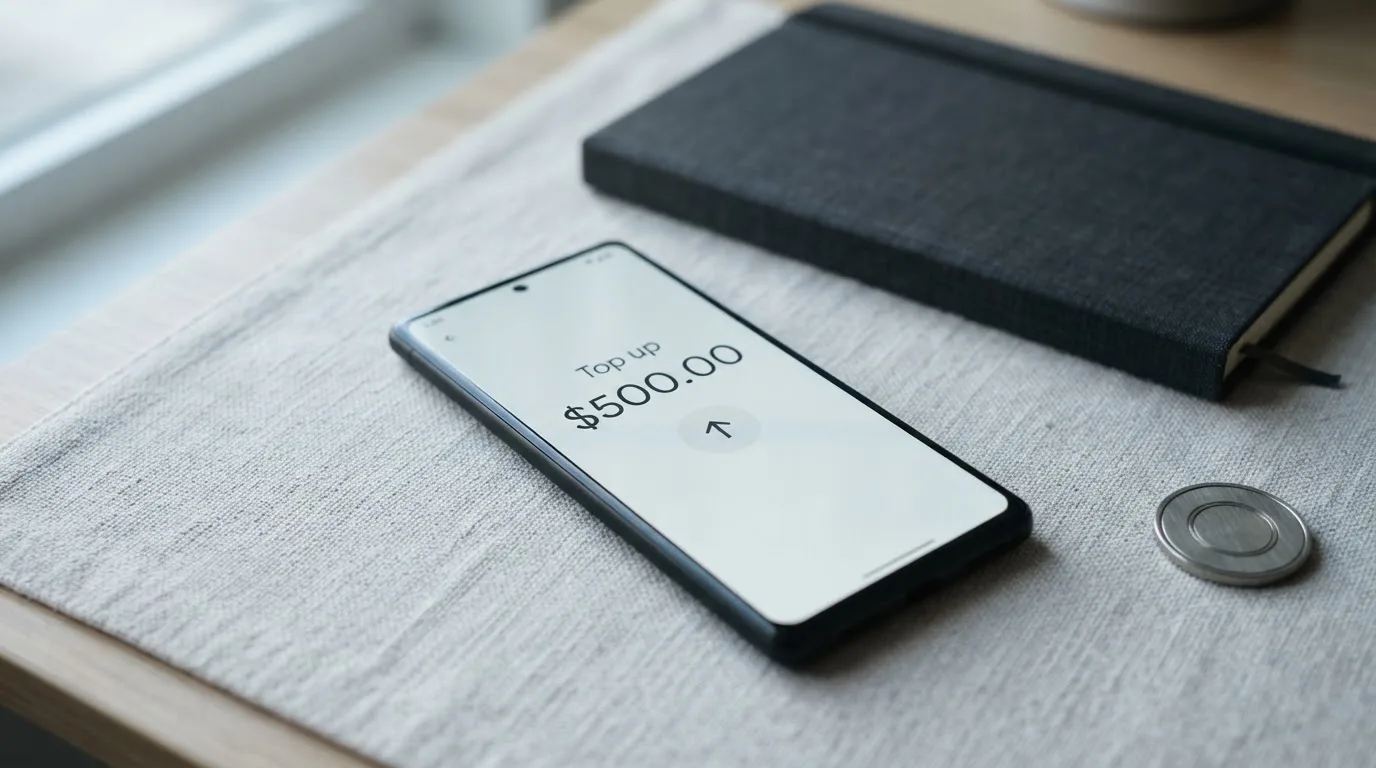
Loading money is the part RedotPay does well, and the default method — on-chain crypto — is free to the card balance. You deposit crypto directly, or buy crypto with a credit card in the app (ETH, USDC, USDT; availability depends on region). The USDT-TRC20 minimum deposit is 1 USDT after network fees. Each asset is accepted only on the networks shown on the Deposit page, and RedotPay may change those networks, so check the page at the time you send rather than trusting an old guide.
There is one route that costs real money and one number you must not miss. Sending in from a mainstream credit or debit card via the Visa Direct service carries a 3% fee, minimum 1 USD. So if you were planning to fund the card from your ordinary bank card, that route is three times more expensive than the 1.00% the card charges when you actually spend.
Also note where the network fee lands: on-chain network fees are charged by the blockchain, not by RedotPay, and they are paid by the sender before your deposit minimum is counted. The card balance top-up itself is free; the chain fee is a separate cost you eat on the way in.
Two practical warnings belong here rather than in a manual. First, the network matters more than the asset: USDC is not natively issued on the Tron network, so a “USDC over TRC20” transfer is not a straightforward option, and sending to an address belonging to a different network can be lost or need manual recovery with no guarantee. Second, blockchain transfers are irreversible, so there is no chargeback button on a misdirected deposit. Copy the address from the Deposit page itself rather than from an old message or a saved contact, because malware that silently swaps a copied address is a well-known theft method. Checking the page at the moment of sending is the whole defence.
What you cannot do is withdraw. Whether you can take money back out of RedotPay to a bank or wallet is not stated on the public pages. That is worth noting if you were picturing this as a two-way bridge rather than a one-way spending card.
| Top-up route | Fee | Minimum | Notes |
|---|---|---|---|
| On-chain crypto deposit to card | Free to balance | e.g. 1 USDT on TRC20 (after network fees) | Only networks shown on the Deposit page; networks may change |
| Buy crypto with a credit card in the app | Region-dependent | Region-dependent | ETH, USDC, USDT |
| Transfer in from a mainstream credit/debit card (Visa Direct) | 3% (min 1 USD) | 1 USD | The costly route |
| Network (gas) fee | Paid by sender, by the chain | — | Not charged by RedotPay |
Paying with it every day: wallets, rewards and the app
Day-to-day spending is the card’s strongest suit, and it earns the 9/10 here. A virtual card supports Apple Pay and Google Pay integration, so the commonest thing people do — tap your phone in a shop — works. The physical card works “globally” with tap or swipe, and ATMs accept it broadly.
What about where you can use it, and what gets declined? RedotPay publishes no formal list of blocked merchant categories. It does say that “Some individual merchants may have their own internal policies regarding prepaid or crypto cards”, that illegal use is banned, and that the card is not usable in sanctioned countries. It gives no MCC (merchant category code) list. So unlike some competitors that name the categories they block, RedotPay is deliberately silent — which means you find out by trying. I built the usual background below, but be aware the practical effect is: expect some declines at merchants that dislike prepaid or crypto cards, and do not expect the provider to tell you in advance which.
The app is in decent shape. On the iOS App Store it holds a 4.75 rating from 4,312 ratings and was updated 2026-09-28 (read 2026-10-20); the Android rating is not stated. In the app you get useful controls: per-card limits, toggles for online / POS / ATM, and the currency toggle.
Rewards are the weak spot. There is a 5 USD welcome reward, but it is usable only on spending and valid for 30 days. The card page lists “Points & Rewards” and “RedotPay Pro” as separate programmes, but no card cashback rate is stated — there is no stated percentage you earn back on everyday spend. Compared with rivals that advertise 1% or more, treat the rewards here as a nudge, not a reason.
One protection to be aware of: the Singapore terms state that fees are non-refundable (clause 16.3) and that the terms allow RedotPay to freeze accounts. That freeze power is the single biggest thing to internalise before you load a large balance.
What can go wrong: freezes, the unnamed issuer and unbacked promises
This is the section I would not skip, because it is why the card is 6.9 and not higher. Two categories of problem converge here: how the service treats you when something is unclear, and what is and is not behind the card.
RedotPay’s own help pages acknowledge freezes. They publish guidance on P2P order handling and note that accounts and funds can be frozen in connection with disputes. On top of that, user reports describe KYC-related holds on funds, support escalations going unanswered for days, and limits on daily payments. The Trustpilot page shows 778 reviews in 2026, with KYC holds, slow support and daily payment limits as recurring themes. A third-party review-analysis site adds that the most serious complaint is freezes during source-of-funds reviews that can last weeks; that characterisation comes from that site and is not something RedotPay confirms.
The pattern that emerges is this: not that RedotPay freezes people at random, but that a freeze tends to happen when your money cannot be explained quickly — a P2P trade, an incoming transfer from someone you do not know, a source of funds that requires documents the app never prompted you for. If your funds come from a clean exchange withdrawal or visible salary, your risk is materially lower.
Behind the card, the structure is thinner than the branding suggests. The App Store seller is “Red Dot Technology Limited”. The Singapore terms name “Redotpay Technology Pte. Ltd.” as the programme manager and refer to an unnamed “BIN Sponsor” as the actual issuer — the bank behind the card is not disclosed. Users must be “ordinarily resident outside of Singapore”. The website footer carries an Argentine line, “N° 144 en el Registro de PSAV de la CNV (República Argentina)”, and the site claims “9 Million+ Users”.
What that means for you is worth stating plainly, because it is the background every crypto card shares. A payment card number begins with an issuer identification number (BIN/IIN) that tells the world which institution issued it; merchants can look it up and apply extra scrutiny when the issuer country differs from your billing address, which is why a foreign-issued card can look “foreign” to a shop. On top of that, Visa and Mastercard do not issue crypto cards to consumers themselves; they license issuers and can suspend a programme. That is not theoretical — Visa terminated its global agreements with FTX on 13 November 2022 and the FTX US debit card was wound down; WaveCrest, a Visa issuer that supplied crypto card brands, was suspended by Visa in Europe in 2018, closing all its Visa programmes. Programme closures follow a pattern: a notice period, then spending and loading stop, then you are asked to withdraw remaining balances.
Which brings me to the promises RedotPay does not make, and I want to be honest about the gaps. Whether your funds are safeguarded or insured, and whether two-factor authentication is offered, are not stated. Support response-time commitments are not stated. Whether you have chargeback rights, and the dispute process itself, are not stated. Fee handling — note the “3% (min 1 USD)” — is fine. And you have no US-style deposit guarantee here; this is not a bank account. I want to be careful not to overstate the risk: I am not telling you this card is unsafe, and I make no promise that it is safe. I am telling you that the safety features I would want to see named — safeguarding, insurance, 2FA, chargeback terms — are not named, so you should hold balances you can afford to have tied up, and understand that freezing is a documented, real possibility.
What to take instead
If the freeze risk is your sticking point, a conventional card from a regulated exchange may suit you better, with the trade-offs spelled out honestly. Here is how RedotPay stacks up against the three most-quoted alternatives.
| Card | Mark | Eligibility | Card type | Cost |
|---|---|---|---|---|
| RedotPay | 6.9 / 10 | Open except KYC + issuance restricted lists | Virtual and physical | 10 USD virtual / 100 USD physical; 1.00% spend |
| Bitpanda | 6.5 / 10 | Verified account + euro-area residence; Bankident-verified users cannot order | Physical Visa debit, EUR only, one active | Free account; reissue EUR 5.90–9.90; extra card EUR 10 |
| Wirex | 6.7 / 10 | Depends on region; official country list not officially stated | Virtual + physical; metal is Visa Signature debit | Free issuance in UK/EEA/APAC/SG/AU/Other; metal 45 GBP (UK) / 45 EUR delivery elsewhere |
| COCA | 6.4 / 10 | “currently available in the UK, EEA, Asia, South America, Middle East and Africa” | Physical and virtual Visa | Not stated |
A few honest contrasts. Bitpanda is the most rules-based: it requires a verified account and residence in a euro-area country, and explicitly excludes users verified via “Bankident”. Its card is EUR-only and physical, and it advertises cashback of 1% (with some pages noting “up to 2%”) with crypto conversion at payment. For an EU reader who wants a regulated, single-currency experience, that predictability may beat RedotPay’s flexibility.
Wirex is the closest in spirit — virtual and physical, spending “cash, stablecoins, and cryptocurrencies” — but its documentation is shakier: the official supported-countries page does not provide a country list. Its fee page does not specify an FX fee (the card page says there is none), and the Singapore terms bar cash withdrawals in Singapore and block “Prohibited Countries”. Its rewards are stronger on paper (Cryptoback in WXT from 0.5% up to 8%) but exclude gambling, cash advances and long lists of merchant categories.
COCA offers up to 8% cashback in stablecoins and “fee-free swaps” and is available across the UK, EEA, Asia, South America, the Middle East and Africa, with restricted jurisdictions defined in its terms. But its public pages state almost nothing about costs, fees and funding mechanics — the terms just say fees are “disclosed at the time you access the Service”. For someone who wants rewards, COCA is interesting; for someone who wants readable numbers, it is frustrating.
None of these is unambiguously safer. My read: if your priority is day-to-day flexibility with a virtual card, Apple Pay and a clear 1% fee, RedotPay is a reasonable pick; if your priority is a card backed by a big regulated exchange with predictable single-currency rules, look at Bitpanda; if you want rewards, compare Wirex and COCA — but verify their country support yourself, since the official Wirex list was unavailable to me.
Who I would recommend it to
I would recommend the RedotPay card to someone who already holds crypto, lives in a country on neither restricted list, can show a clean and explainable source of funds, and wants a single card that handles both online and in-person spending with Apple Pay and Google Pay, at a transparent 1% conversion fee and no monthly charge. For that person it does exactly what it promises, and the virtual-plus-physical choice, the free balance top-up and the worldwide ATM reach add up to a genuinely useful everyday tool.
I would not push it at someone whose funds arrive in complicated ways, who is likely to need large sums cleared quickly, or who wants deposit-insurance-like protection — because the freeze risk is real and documented, the issuing bank is not even named, and safeguarding and chargeback terms are not stated. I would also not push it to residents of the restricted countries, who cannot have virtual or physical cards and cannot use those addresses for billing.
Between those two groups lies the honest middle: try it, fund it modestly at first, and see how it behaves with your own money before you trust it with a large balance. That is not evasion — it is the ordinary prudence any reasonable person should apply to a prepaid-style card whose provider can freeze accounts.
Frequently asked questions
What is the RedotPay card?
It is a crypto-linked Visa-branded payment card, sold as a virtual card for online spending or a physical card for tap, swipe and ATM use. You load it with crypto, it converts into a spendable balance, and the card draws on that. It is not a bank account; the issuer is an unnamed “BIN Sponsor”.
How does the RedotPay card actually work?
You deposit crypto on-chain, or buy crypto with a credit card in the app, and it lands as a spendable balance. Each payment draws that balance down, with a 1.00% conversion fee, plus 1.20% more if the payment is in a non-default currency. Because the card draws on a stored balance, it cannot overdraw.
Is RedotPay a bank, and who issues the card?
No. RedotPay is a card programme manager, not a bank. The Singapore terms name Redotpay Technology Pte. Ltd. as programme manager and an unnamed “BIN Sponsor” as the actual issuer, and require users to be ordinarily resident outside Singapore. Your balance is therefore not a bank deposit.
Can I get a RedotPay card in my country?
It depends on two lists. A KYC list blocks citizens of the listed countries, and a 47-place card-issuance list dated 28 August 2026 additionally bars residents of India, Indonesia, Morocco, Nepal, Singapore and Turkey from both card types. Russia, Belarus, Ukraine and Serbia are on both lists; Georgia, Armenia and Kazakhstan on neither.
Does RedotPay require KYC, and what documents do I need?
Yes, and the documents are strict. You must be at least 18 and verify your identity first. Only original physical IDs are accepted — no copies, screenshots or photos of a screen. The ID must be valid at least three months from submission, and both sides are needed if data appears on the back.
How much does a RedotPay card cost to get and keep?
A virtual card costs 10.00 USD to apply and a physical card 100.00 USD, not refundable once paid. Replacing a virtual card is 5.00 USD the first time, 10.00 USD after. Keeping the account is free, with no monthly or inactivity fee. Spending costs 1.00% per transaction, and 1.20% in a non-default currency.
How do I top up the RedotPay card, and which network do I use?
On-chain crypto deposit is the main route free to your card balance, with a minimum as low as 1 USDT on TRC20 after network fees. Each asset is accepted only on the networks shown on the Deposit page, and those may change. Sending from a bank card via Visa Direct costs 3%, min 1 USD.
Is the RedotPay card safe, and can my account get frozen?
I cannot promise you safety, so plan around freezing. RedotPay’s help pages mention freezes tied to P2P orders and disputes, and the Singapore terms let it freeze accounts. Users report KYC holds and slow support; a third-party site says source-of-funds freezes can last weeks. Hold only what you can afford to have tied up.
Where can I use the card, and does it work with Apple Pay?
The virtual card integrates with Apple Pay and Google Pay, and the physical card works globally with tap or swipe, including at ATMs. No fixed list of blocked merchant categories is published, so some shops that dislike prepaid or crypto cards may decline it. It cannot be used in sanctioned countries.
How do I withdraw money, and is there cashback?
Whether you can withdraw to a bank account or wallet is not stated, so treat the card as a one-way spending tool. There is a 5 USD welcome reward, usable only on spending and valid 30 days, but no cashback rate is published. The card page lists “Points & Rewards” without a percentage.
Created by the ”Crypto Card Rating” editorial team.