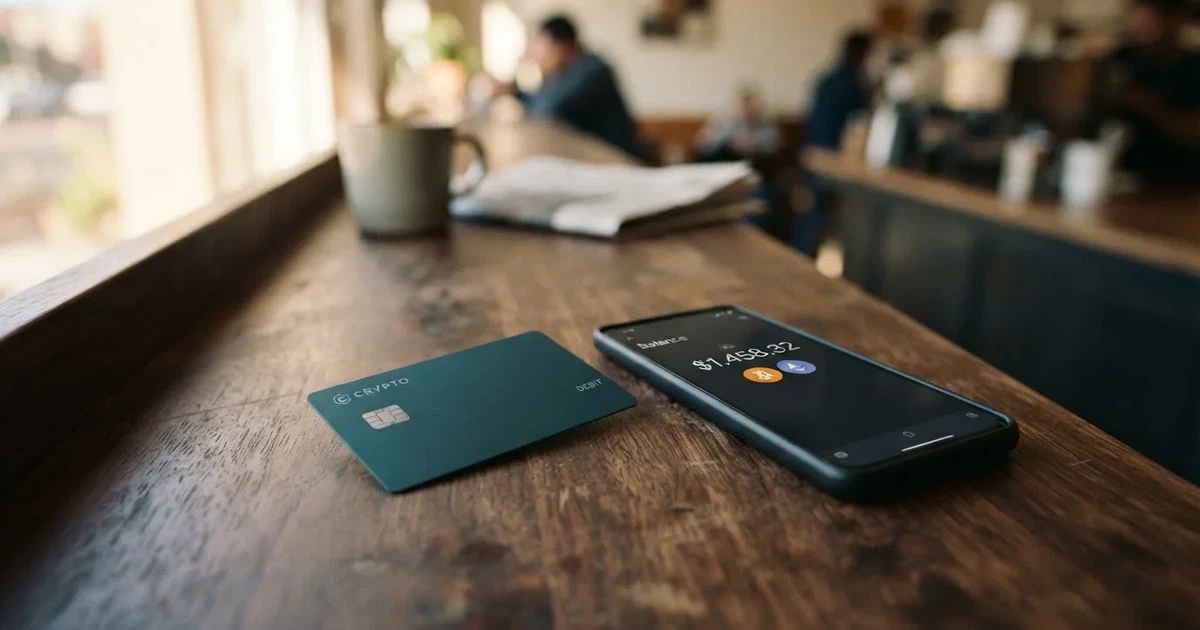
Fizen Card review: a Hong Kong prepaid card, not a bank account
Fizen is not a bank, and it does not pretend to be one. What it is: a Hong Kong company that lets you hold USDT and spend it through a USD Visa prepaid card, mostly a virtual one you add to Apple Pay or Google Pay. If that is exactly your situation — you already have stablecoins, you want to pay with them, and you are not expecting a bank account, a chequebook or a support agent who rings you back — then a card like this solves a real problem. If you want a normal everyday bank card in your own currency, with a local IBAN, a local phone number and dispute rights that your regulator will enforce, Fizen solves nothing at all.

My score for Fizen is 6.4 out of 10. That is a mid-table number and it is not a punishment; it is what happens when a product does one narrow job competently, prices it plainly, and leaves a great deal unsaid on its public pages.
The conditions described here are current as of 21 October 2026.
Verdict: 6.4 out of 10, built for people already holding USDT
The single sentence version: Fizen is a crypto card, not a financial service, and you should judge it against other crypto cards rather than against your old bank.
Who it suits. You are outside the countries Fizen blocks, you keep money in USDT, you are comfortable converting crypto to spend it, you mostly pay online or by phone, and you do not need interest, a local account, or a plastic card in your hand right now. The virtual card is issued instantly and works with Apple Pay and Google Pay, which covers most contactless terminals.
Who it does not suit. Anyone who needs a physical card this week — the metal Pioneer and Frontier cards are still listed as “coming soon”. Anyone who wants to spend their salary from a bank account. Anyone whose country of citizenship is on Fizen’s 43-country exclusion list, and anyone reading this from Russia, because the Russian Federation is on that list. Anyone who expects to hold large balances for a long time and treat them like a bank deposit.
| Criterion | Mark | Why |
|---|---|---|
| Who can get it | 8 / 10 | Card unavailable in 43 countries including Russia, Belarus, Serbia, India, China (Mainland), Iran and Ukraine; use claimed in 160+ countries |
| Cost | 6 / 10 | Adventure issuance $9.99; $0 monthly if you spend $500+, otherwise $1.50; FX 1%, crypto conversion 0.5%, closing the card $2.00; ATM $2 + 1.5% |
| Top-up options | 6 / 10 | USDT into a Fizen-controlled wallet; QR Pay takes USDT on Solana or BNB Chain only; fiat through Transak |
| Reliability and complaints | 6 / 10 | Fizen Limited, Hong Kong, not a bank or licensed payment institution, issuer unnamed in the public terms; Tether investment announced 30 July 2026; Trustpilot 4.1 out of 5 |
| Everyday use | 5 / 10 | Virtual Visa immediately, Apple Pay and Google Pay; metal cards “coming soon”; ATM only on the physical card, first withdrawal up to $200/month free |
The everyday-use mark is the weakest of the five, and that tells you where the product is today: one usable card type, with the nicer ones promised.
Will they give you the card?
Officially, no, if you are in one of 43 listed countries — and Russia is on that list, alongside Belarus, Serbia, India, China (Mainland), Croatia, Slovenia, Montenegro, North Macedonia, Bosnia and Herzegovina, Iran, Ukraine and Venezuela.
This is the part worth reading twice, because “where you live” and “what passport you hold” are two different questions, and Fizen answers both.
Where you live (residence, IP, location). The card page claims use in 160+ countries. The Master Terms, in clauses 5.1 and 5.2, say that users cannot be citizens, residents, or located in a jurisdiction where the service is prohibited or under comprehensive sanctions. Notice what the terms do not do: they name no countries at all. There is no Russia or Belarus text in them. The named list lives on a separate help page, and that list is what governs.
What citizenship you hold. Fizen’s own unsupported-countries page carries an exception line: “If you’re a citizen of a restricted country but currently live in a supported country, you may still be eligible.” I did not read the underlying exceptions page, so I am giving you that sentence as written and not as a promise. Citizenship-based screening is normal in this industry — sanctions checks are routinely run against nationality and country of birth, separately from residence — so do not read the exception as a workaround. Read it as one narrow case where the company says it may look at your circumstances individually.
Practical consequences, stated plainly and without speculation about how to get around anything:
- Living in Russia: the card is unavailable. There is no supported version of this product for residents of the Russian Federation.
- Living in another CIS country: check the list carefully, because it is not obvious. Georgia, Turkey, Kazakhstan, Armenia and the UAE are not on the 43-country exclusion list. Serbia, Belarus and Ukraine are.
- Russian citizens living elsewhere: your eligibility turns on where you are, not only on your passport — but screening against citizenship is separate, so a decision can go either way and Fizen’s public pages do not explain the reasoning.
| Situation | What the official pages say |
|---|---|
| Resident of Russia, Belarus, Serbia, Iran, Ukraine | Card not available (43-country list) |
| Resident of Georgia, Turkey, Kazakhstan, Armenia, UAE | Not on the exclusion list; no supported-country list published |
| Citizen of a listed country, resident of an unlisted country | Fizen says you “may still be eligible”; detail not published |
| Anywhere | Terms bar citizens, residents and located persons in prohibited or comprehensively sanctioned jurisdictions, without naming any |
One more thing that never gets said out loud: because the company is Hong Kong-based and lists sanctions-style exclusions, the list can change without much notice. The Master Terms were effective 5 June 2026 and say material changes take effect 30 days after notice. That is a feature of the contract you accept, not a loophole.
How to get it
Short version: download the app, open a wallet, follow the “get card” path. The application takes 5 minutes, and a virtual card appears immediately. Fizen publishes its Super App for iOS and Android. I found no App Store or Google Play ratings to quote you, so I cannot tell you how people rate the software.
What is published about verification is thin, and I would rather say that than dress it up. The terms require KYC “at the level each Service requires”, and eligibility is checked at onboarding and on an ongoing basis — KYC, IP, device and location. Fizen’s blog describes it as a one-time verification “like any regulated payment app”. But the specific documents are not stated, the age threshold is not stated, the levels are not published, the processing time is not published, and the rejection reasons are not published. That last one matters: without it, if you are turned down, you will not know whether it was the paperwork, the network, the address pattern or the country.
On the card itself, Fizen says Visa, and the card terms are titled for a “USD Visa Prepaid Card”. The terms describe the issuer as a regulated institution operating “under licence from Visa” — but the issuer is not named in the public material I read; it appears only in the Issuer Cardholder Agreement. If the identity of the bank behind your card matters to you, that agreement is the document to read before you fund anything.
The tier structure matters here because only one tier is real:
| Tier | Price | What you get | Status |
|---|---|---|---|
| Adventure | $9.99 | Virtual card, Scan-to-Pay, eSIM/hotel/flight discounts and cashback, 0 trading fee on US stocks and ETFs (first $5,000), 5% APR bonus on USDT Vault, free ATM quota, priority support | Open now |
| Pioneer | $999.99 | Everything in Adventure plus a physical metal card, 10% APR bonus, higher FiPoint cashback, VIP support | Coming soon |
| Frontier | $9999 | Everything in Pioneer plus a metal card, 20% APR bonus, higher FiPoint cashback, VIP support; 100+ card skins “coming soon” | Coming soon / “Get info” |
Note that $9.99 was free for pre-registered users, per the official fee page — a promotion, not a standing price.
What it really costs: Fees
Here is the honest picture, and I want to flag a contradiction before you meet it in the table. Fizen’s card page advertises Adventure with “0 crypto-to-fiat conversion fees” and “0 top-up fees within plan limits”. The documentation fee table lists crypto-to-fiat conversion at 0.5% as the standard rate. Both are official Fizen sources. I cannot reconcile them from the public pages, so treat the 0.5% as the safe planning assumption and check the app, which is said to show the rate before you confirm.

| Fee or limit | Value |
|---|---|
| Virtual card issuance | $9.99 (free for pre-registered users) |
| Monthly maintenance | $0 if spending $500 or more in the period; $1.50 if under (first month free) |
| FX fee on non-USD payments | 1% (0% on USD payments) |
| Crypto-to-fiat conversion | 0.5% standard (card page advertises 0 for Adventure) |
| Small transaction fee | $0.50 per transaction under $50 |
| ATM withdrawal | $2 + 1.5% |
| First ATM withdrawal | Up to $200/month free, physical card only |
| Closing the card | $2.00 |
| Per transaction | $150,000 |
| Daily spending | $1,000,000 |
| Monthly spending | $1,000,000 |
| ATM limits | $100,000/day, $200,000/month; 3 per day, 30 per month |
Some fees are waived by card benefits, per the official fee page — which is another way of saying the table above is a ceiling, not always the bill.
Three ordinary payments, priced with the published figures so you can see how the layers stack.
A $20 lunch paid in USD. If your balance is already dollars and the merchant prices in dollars, the FX fee does not apply. Nothing to pay beyond whatever the merchant charges. This is the cheapest case and it is the one Fizen is built around.
A lunch in a country that bills in euros. You pay a 1% FX fee and a 0.5% crypto-to-fiat conversion fee. If the payment is under $50, you also pay the $0.50 small-transaction fee. These fees stack, so small foreign payments carry the heaviest percentage cost.
A taxi in a local currency, two or three times a month. You pay the 1% FX fee and 0.5% conversion fee. If the amount is over $50, the small-transaction fee does not apply. ATM withdrawals cost $2 plus 1.5%, though the first withdrawal up to $200 per month is free, which makes cash attractive if the terminal is difficult to use.
The line to watch in the daily column is the $500 spending threshold. Below it you pay $1.50 a month. If you spend slightly more, the fee goes to zero. That is an unusual structure — it rewards activity rather than penalising idleness — and if you were planning to hold the card mostly idle, the real cost is $9.99 plus $1.50 a month, forever, plus $2 to close it.
How to Top up the card
The card is funded by transferring USDT to a Fizen-controlled wallet. That is the whole mechanism, and it carries two consequences you should hold onto: the balance is custodial (see the risks section), and your deposit must actually arrive.
Fiat entry exists, but it is third-party. The terms route the on-ramp and off-ramp through providers such as Transak, and you buy the crypto there first. The fee schedule shows no top-up fee line at all, and the card page says “0 top-up fees within plan limits”. Minimum top-up is not stated. Network fees on the blockchain are not Fizen’s revenue — they go to the validators of whatever network you used.
QR Pay is a separate product with a much narrower door. It is funded only with USDT on the Solana or BNB Chain networks. The warning in the terms is stark and I am repeating it because it is the kind of thing that ends badly: other networks or tokens sent there may be permanently lost. Sending USDT on Ethereum to a Solana-only address is not a support ticket, it is a donation.
| Top-up route | What it is | What to watch |
|---|---|---|
| USDT transfer | Send USDT to a Fizen-controlled wallet | Wrong network or token can be lost; minimum not stated |
| QR Pay | USDT only, Solana or BNB Chain only | Other networks or tokens may be permanently lost |
| Fiat via Transak | Buy crypto through a third-party on-ramp | Third-party KYC, third-party pricing, third-party delays |
Getting money back off the card is where the documents get vague, and you should read the balance question before you load, not after. Closing the card costs $2.00. QR Pay balance can be discharged through withdrawal “where available”, with Fizen undertaking to “provide a reasonable method”, which may require identity verification, proof of source of funds, or a verified destination address. The terms reassure you that QR Pay balance will not be forfeited merely because access is suspended or terminated. For the card balance itself, the withdrawal terms live in the Card Terms and the Issuer Cardholder Agreement, which I did not read.
The Master Terms do say one reassuring thing: wallet assets stay on-chain after you stop using the platform.
Paying with it every day
The virtual card is the product. Apple Pay and Google Pay logos are shown, so in practice your phone is the card. Apple Pay replaces the card number with a device-specific number stored in the Secure Element, never on Apple’s servers, and generates a one-time code per payment. Your issuer can also restrict the tokenised number — blocking it, for example, on magnetic-stripe or phone use — so a tokenised card is not automatically usable everywhere.
QR Scan-to-Pay works in countries including Brazil, Argentina, Peru, Vietnam and the Philippines. That list tells you something about where Fizen is actually pushing. Whether specific merchant categories are blocked is not stated; the terms simply prohibit illegal gambling and other illegal activity.
Rewards exist in the upper tiers of each scheme. Adventure gives discounts and cashback on eSIMs, hotels and flights, “FiPoint cashback” at a rate that is not stated, and a 5% APR bonus on the USDT Vault; Pioneer and Frontier raise that to 10% and 20% APR bonuses with higher FiPoint cashback. Fizen’s blog also advertised “up to 10% cashback + FiPoints on every spend” with terms and conditions applying, and a $10 eSIM credit offer on 19 August 2026. I would treat the cashback rate as unconfirmed until you see it in your own app.
Two everyday friction points that are not Fizen’s fault but will still cost you money. Address verification compares the numeric parts of the billing address you type with issuer records, and it is generally unavailable for foreign-issued cards — which is exactly what yours is — so some online checkouts will decline. And a declined authorisation can leave a hold on your funds for several days, typically up to seven. A card that looks “foreign” in the BIN lookup can also attract extra scrutiny at the till.
If a payment goes wrong, the route is formal and slow. You send a written Notice of Dispute to [email protected], Fizen has 60 days to resolve in good faith, and then it goes to SIAC arbitration in Singapore, with class actions waived. Claims must be brought within one year. The terms add that blockchain transactions are generally irreversible and that Fizen may reverse one “where technically possible”. Chargebacks are not addressed in the Master Terms; the Card Terms and FAQ pages exist and I did not read them.
What can go wrong
You are trusting a non-bank with your money. Fizen Limited is registered in Hong Kong (company number 77059696, Unit 1411, 14/F, Cosco Tower, Queen’s Road Central). Its own terms state that it is not a bank, not an e-money institution and not a licensed payment institution. European e-money institutions, by contrast, must safeguard customer funds in segregated accounts or insure them — and even then those funds are not bank deposits. Fizen’s terms give no such promise.
The balance model is custodial, in three different ways. Fizen Wallet and Swap are non-custodial: the private key is generated on your device, encrypted locally, and Fizen cannot recover it. Fizen Card is not — it is a custodial balance, with assets pooled on Fizen’s internal ledger. QR Pay is weaker still: ownership of accepted assets passes to Fizen and is not segregated. Read that as three products with three different risk profiles under one brand.
Transfers are one-way. Blockchain transfers are typically irreversible, and a stolen private key has no recovery mechanism — the network cannot freeze or return funds. Custodial platforms have a real history of failure: Mt. Gox, about US$350 million reported stolen between 2011 and 2014; Coincheck, about US$400 million in 2018; Ronin Network, US$625 million in 2022. Stablecoins are not censorship-proof either; Tether says it disables tokens in wallets on the OFAC sanctions list and has frozen funds tied to illicit activity.
The Visa programme could end. Visa and Mastercard do not issue crypto cards to consumers; they license issuers and can suspend a programme. Visa terminated its global agreements with FTX on 13 November 2022 and the FTX US debit card was wound down. In 2018 Visa suspended WaveCrest in Europe, closing all WaveCrest-issued Visa programmes. Closures follow a pattern: notice, then loading and spending stop, then you are asked to withdraw. One 2026 closure reported by a secondary source ended new loads on 8 July 2026 and spending on 8 August 2026 — a single unconfirmed source, but the shape of it is the shape you should expect.
The reputation is thin but not bad. Trustpilot shows 4.1 out of 5, with the visible reviews all five-star between 21 April and 3 June 2026, and the company replied to each. One reviewer describes the app as “a bit buggy” sometimes. No recurring complaints, and no Reddit threads surfaced in my search. Trustpilot does carry a note that the company “may be associated with high-risk investments”. I read that as a platform flag, not a finding of wrongdoing.
Backing changed hands recently. On 30 July 2026 Tether announced a strategic investment in Fizen; the amount was not disclosed. A $FIZEN token had not launched as of June 2026. Tether’s involvement is a genuine positive for USDT liquidity and a genuine concentration of risk: the largest stablecoin issuer in the world now has a financial interest in a company that converts USDT to card spend.
Compliance and sanctions still bind you. This is the part I will not dress up: if you are in Russia or Belarus, or subject to sanctions in your jurisdiction, the exclusion list and the terms are the controlling facts, and no card, wallet or review changes them. Since March 2022, after Visa and Mastercard suspended operations in Russia, cards issued by Russian banks stopped working abroad — which is precisely why people look for foreign-issued cards, and precisely why the providers building them publish exclusion lists.
Your remedy is Singapore arbitration. Under EU rules, an institution that cannot complete due diligence must decline the transaction and may end the relationship — so account freezes pending documents are a lawful outcome, not a punishment. But Fizen’s dispute route is not a local regulator: it is a Notice of Dispute, 60 days, SIAC arbitration in Singapore, class actions waived.
The issuer is not named. The public terms say “a regulated institution under licence from Visa” without naming it. That is unusual for a card you are asked to load money into.
Support is English-only and in-app. Fizen offers in-app live chat, [email protected], Discord, and [email protected] for notices; the card page claims 24/7 support with priority and VIP tiers. The terms state English prevails — Russian is not mentioned. Two-factor authentication must be enabled where offered, and unauthorised access should be reported to [email protected] within 72 hours. Card management (freeze and controls) exists on a help page I did not read; insurance is not stated anywhere.
What to take instead
Three alternatives, on their own published terms.
RedotPay — 6.9 / 10. Two official lists word the rule differently. The KYC list says citizens of listed countries “will not be able to complete identity verification or use RedotPay’s services”, citing local regulation and sanctions policy rather than individuals; listed are Afghanistan, Belarus, Bosnia and Herzegovina, Congo (DR), Croatia, Cuba, Mainland China, Montenegro, North Korea, North Macedonia, Russia, Serbia, Slovenia, Somalia, Sudan, Syria, Ukraine, Venezuela, Yemen, Zimbabwe and others. A separate card-issuance list dated 28 August 2026 adds India, Indonesia, Morocco, Nepal, Singapore and Turkey as ineligible for both virtual and physical cards and unusable as billing addresses. Georgia, Armenia, Kazakhstan and the UAE appear on neither list. Costs: $10.00 virtual application, $100.00 physical (non-refundable once paid), virtual replacement $5.00 then $10.00, no monthly or annual fee. Transaction fee 1.00%, non-default currency 1.20%, small-auth fee $0.20 after five free per month, declined transactions $0.50 after three free. Some merchants carry 1.5% (minimum $0.50). Deposit: USDT-TRC20 minimum 1 USDT after network fees; deposit to card balance is free. A $5 welcome reward is spending-only, valid 30 days, and cannot offset the issuance fee. RedotPay Pro costs $12.90 monthly or $129.00 annually. Cards: USD and HKD.
Bitpanda — 6.5 / 10. A completely different proposition: a regulated European exchange with a physical Visa debit card, but EUR only, residence in a euro-area country required, and accounts verified via “Bankident” excluded. No monthly cost, first shipment free; reissue EUR 5.90, or EUR 9.90 for lost or stolen per the FAQ, and EUR 10 per additional card. Non-EUR transactions carry EUR 0 in FX fee but “VISA mark-up fees apply”. Spending draws on a chosen main asset — listed cryptocurrencies, precious metals or EUR — auto-converted to EUR, with Crypto Indices excluded and a EUR 1 minimum payment. Cashback is stated as 1% on crypto spending in the body text and “up to 2%” in the page summary, which the site does not reconcile; fiat, stocks, metals and stablecoins are excluded. It scores just above Fizen, and for a euro-area resident with a job it is the sturdier option.
Wirex — 6.7 / 10. Card availability “depends on your region”, and the official supported-countries list could not be read, so there is no country list to check — a real drawback when your whole question is “will they issue to me?”. The homepage claims “Worldwide (130+ countries)”. Singapore terms bar cash withdrawals there and block transactions with “Prohibited Countries”. Cards are one virtual plus one physical at a time, Visa or Mastercard depending on region; the metal card is a Visa Signature debit card. Issuance is free in the UK, EEA, APAC, SG, AU and “Other”; the UK metal card is 45 GBP with free DHL Express, elsewhere “only 45 EUR” delivery. The card page advertises no annual or foreign exchange fees, but the fee page gives no FX number, only rates viewable in the app. Top-ups come from another Wirex account, from another person, or via a third-party payment provider; fiat deposits by SEPA, Faster Payments, ACH and PIX are free. Cryptoback runs 0.5% standard, 3% Premium, up to 8% Elite, and is excluded on ATM withdrawals, cash advances, crypto purchases, gambling and refunds, plus a list of merchant category codes.
| Fizen | RedotPay | Bitpanda | Wirex | |
|---|---|---|---|---|
| My score | 6.4 / 10 | 6.9 / 10 | 6.5 / 10 | 6.7 / 10 |
| Network | Visa, USD | Visa, USD and HKD | Visa, EUR only | Visa or Mastercard by region |
| Card form | Virtual now; metal coming soon | Virtual and physical | Physical | Virtual and physical |
| Issuance | $9.99 | $10.00 virtual; $100.00 physical | Free, first shipment free | Free in listed regions; metal 45 GBP / 45 EUR |
| Monthly fee | $0 if spending $500+, else $1.50 | None | None | None stated |
| Russia / Belarus | Not available | Not available | Not stated | No country list published |
| Funded by | USDT to Fizen wallet; fiat via Transak | Crypto deposit or in-app purchase | Main asset converted to EUR | Cash, stablecoins, crypto |
For a Russian speaker specifically: Fizen and RedotPay are both closed doors. Bitpanda’s rules turn on residence in the euro area, and Wirex publishes no list at all — so between them, only Wirex leaves a question you could conceivably get an answer to, and it will be answered by their support desk, not by me.
Who I would recommend it to
Recommend it if all four of these are true. You already hold USDT or are comfortable buying it. You live somewhere Fizen does not exclude, and your citizenship does not close the door under the screening it applies. You are willing to treat the balance as money sitting with a Hong Kong company, not as a bank deposit. And you mostly pay by phone or online, so the missing plastic card does not matter.
Do not recommend it if your money is your salary, if you need to walk into a shop abroad and hand over something physical, if you intend to hold tens of thousands of dollars on the platform as a store of value, or if a local chargeback scheme is the protection you are counting on.
And check the two things I could not: read the Card Terms and Issuer Cardholder Agreement for who the issuer is and how balances come out, and look up your country on the unsupported-countries page yourself, because the list can change and I cannot tell you what it will say tomorrow.
Frequently asked questions
What is Fizen card?
Fizen is a Hong Kong company that turns stablecoins into card spending. You load USDT into a Fizen-controlled wallet, and a USD Visa prepaid card draws on that balance. What you hold is a prepaid card balance on an internal ledger, not a bank account, and Fizen’s own terms say it is not a bank, e-money institution or licensed payment institution. The issuer’s name is not in the public terms.
Is Fizen a bank?
No, and Fizen says so itself. The terms state the company is not a bank, e-money institution or licensed payment institution, which matters because a European e-money institution must safeguard customer funds in segregated accounts or insure them, and even that is not a bank deposit guarantee. The card is described as issued by a regulated institution under licence from Visa, but that issuer is named only in the Issuer Cardholder Agreement.
Is the Fizen card available in Russia?
No. The Russian Federation is on Fizen’s list of 43 countries where the card is unavailable, alongside Belarus, Serbia, India, China (Mainland), Iran, Ukraine and Venezuela. Residents of Georgia, Turkey, Kazakhstan, Armenia and the UAE are not on that list, but no supported-country list is published either. Being a citizen of a listed country while living in an unlisted one may still be eligible, per Fizen’s own wording.
How do I get a Fizen card?
Download the Fizen Super App for iOS or Android, open a wallet, and follow the get-card path. The application takes 5 minutes and the virtual card is issued instantly. Documents, age threshold, verification levels, processing time and rejection reasons are all not stated in the public pages, so do not expect to know in advance what paperwork will settle it.
Does the Fizen card require KYC?
Yes. The terms require identity verification “at the level each Service requires” and say eligibility is checked at onboarding and on an ongoing basis, covering KYC, IP, device and location. Fizen’s blog describes it as a one-time verification like any regulated payment app. The specific documents and the levels are not published, which is the practical gap to plan around.
How much does a Fizen card cost?
The Adventure virtual card is $9.99 to issue, though the official fee page says it was free for pre-registered users. Maintenance is $0 a month if you spend $500 or more in the period and $1.50 if you spend less, with the first month free. FX is 1% on non-USD payments, crypto-to-fiat conversion is listed at 0.5% standard, small transactions under $50 cost $0.50, ATM is $2 plus 1.5%, and closing the card costs $2.00.
How do I top up the Fizen card?
You transfer USDT to a wallet controlled by Fizen. Fiat entry runs through third parties such as Transak, where you buy the crypto first. QR Pay is a narrower product funded only with USDT on the Solana or BNB Chain networks, and the terms warn that other networks or tokens sent there may be permanently lost. Network fees on the blockchain go to validators, not to Fizen.
Can I use the Fizen card in Apple Pay and Google Pay?
Yes, both logos are shown on the card page and this is the main way people use the virtual card today. Apple Pay replaces the card number with a device-specific number stored in the Secure Element, and each payment uses a one-time dynamic code. The issuer can still restrict the tokenised number, for example blocking it on magnetic-stripe or phone use, so it is not universally accepted.
Is the Fizen card safe?
It depends which product you mean. Fizen Wallet and Swap are non-custodial: the key is generated on your device and Fizen cannot recover it. Fizen Card is custodial, with assets pooled on Fizen’s internal ledger. QR Pay is weakest, because ownership of accepted assets passes to Fizen and is not segregated. Transfers are generally irreversible, and reported losses at custodial platforms include Mt. Gox, Coincheck and Ronin Network.
What happens if Fizen closes down?
Visa and Mastercard license issuers and can suspend a programme: Visa ended its global agreements with FTX on 13 November 2022, and suspended WaveCrest in Europe in 2018. Closures follow a pattern of notice, then loading and spending stop, then users are asked to withdraw remaining balances. Fizen’s terms say QR Pay balance will not be forfeited merely because access is suspended, but card balance withdrawal terms sit in documents I did not read.
Published by the Crypto Card Rating team.